
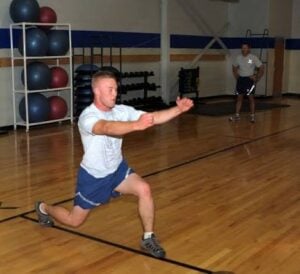
 A lunge is a foundational lower-body strength training exercise where you step forward, backward, or to the side, lowering your hips until both knees are bent at roughly 90-degree angles.
Muscles Worked
Quadriceps: Primarily targeted during the front leg’s ascent or when keeping an upright torso.
Glutes & Hamstrings: Heavily engaged, particularly in reverse lunges or when leaning the torso slightly forward.
Calves & Core: Act as stabilizers to maintain balance during unilateral/single-leg movements.
Common Variations
Forward Lunge: Steps forward, placing higher load and deceleration demands on the front quad and knee.
Reverse Lunge: Steps backward, which reduces shear force on the front knee and places more emphasis on the glutes and hamstrings.
Walking Lunge: Moves continuously forward in a dynamic sequence to improve cardio and single-leg stability.
Side / Curtsy Lunge: Moves laterally or diagonally to engage the inner and outer thigh muscles (adductors and abductors).
Lunges: Benefits, technique, and variations
Benefits of lunges
Quadriceps: Strengthens the front of the thighs. Gluteal muscles: Develops hip and buttock strength. Hamstrings: Improves posterior thigh strength. Balance: Improves stability and coordination. Mobility: Helps maintain hip and ankle flexibility. Functional strength: Improves walking, climbing stairs, and getting up from a chair. Avoid allowing the knee to collapse inward or letting it move uncontrollably.