
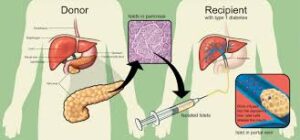
 Islet cell transplantation is a specialized β-cell replacement therapy for adults with type 1 diabetes who experience severe hypoglycemia or glycemic instability despite optimal medical management.
It involves the transplantation of isolated islets from a donor pancreas into another person, usually via infusion into the liver through the portal vein.
Once transplanted, the islets produce insulin, actively regulating blood glucose levels.
However, if cells are not from a genetically identical donor, the recipient’s immune system recognizes them as foreign and mounts a rejection response.
Clinical Efficacy
Approximately 74% of patients achieve insulin independence two years after autologous islet transplantation via portal vein infusion.
For an average adult (70 kg), a typical transplant requires about one million islets, isolated from two donor pancreases.
Outcomes improve with higher mean islet mass (from 2–4 donor pancreases) and glucocorticosteroid-free immunosuppression protocols.
Graft survival rates range from 40–65% over 10–20 years, with 40–73% maintaining insulin independence for several years.
Most recipients experience prevention of severe hypoglycemia and improved glycemic control, even if insulin is later resumed.
Indications
The procedure is primarily indicated for patients with: Type 1 diabetes and recurrent severe hypoglycemia. Glycemic instability unresponsive to intensive medical therapy.
It is less invasive than whole-pancreas transplantation and is suitable for older patients or those with comorbid conditions.
Isolation and Transplantation Technique
A mixture of highly purified enzymes (collagenase) is used to isolate islets from the pancreas of a deceased donor.
Collagenase solution is injected into the pancreatic duct running through the head, body, and tail of the pancreas.
The enzyme causes distension and digestion until islets are liberated.
Purified islets are infused via a catheter into the portal vein of the liver, guided by ultrasound and radiography.
Functional Limitations
– Intrahepatic islets are unable to secrete glucagon during hypoglycemia.
The infusion process can trigger inflammation, destroying many newly transplanted islets.
Immunosuppression
A combination of immunosuppressive agents is required, including daclizumab, sirolimus, and tacrolimus.
While these drugs can prevent failure for months to years, they increase risks of infection, malignancy, and metabolic complications.
Agents such as calcineurin inhibitors and rapamycin may impair normal islet function and insulin action, and have side effects including edema, anemia, oral ulcers, hypertension, hyperlipidemia, weight loss, diarrhea, and renal impairment.
Adverse events related to immunosuppression affect up to 44% of recipients.
Chronic Pancreatitis and Autotransplantation
For chronic pancreatitis treated with total pancreatectomy and autotransplantation: 73% experience pain relief. 80% achieve insulin independence, especially with 2500 IEQ/kg infused.
No patients develop diabetes when insulin-free for two years or longer.
Mild fibrosis predicts higher success rates.
However, limited resections and drainage procedures reduce islet yield and viability.
Emerging Therapies
Zimislecel an allogeneic stem cell–derived islet therapy, can restore physiologic islet function using glucocorticoid-free immunosuppression.
CRISPR/Cas12b and lentiviral transduction have enabled genetically edited β-cells that evade immune rejection without systemic immunosuppression.
In a phase 1/2 trial, 83% of zimislecel recipients achieved insulin independence at one year with excellent glycemic control and no severe hypoglycemic episodes.
The typical time to full C-peptide production is 90–180 days post-transplant.
Limitations and Ongoing Research
Islet transplantation remains constrained by donor scarcity, variable islet quality, and the need for chronic immunosuppression.
Research focuses on: – Pluripotent stem cell–derived β-cells. – Encapsulation devices to prevent immune attack. – Immune-evasive cell lines and localized immunomodulation to eliminate systemic immunosuppression.
Regulatory Status
Allogeneic islet transplantation is regulated as a cell therapy.
The first product, **donislecel-jujn**, gained FDA approval in 2023 for adults with type 1 diabetes and recurrent severe