
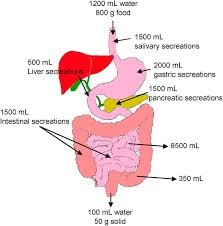
The GI tract produces a variety of secretions that work together to digest food, protect the gut lining, and absorb nutrients.
Gastrointestinal (GI) secretions are the fluids and substances produced by various organs and glands along the digestive tract.
These secretions essential roles in lubricating food, initiating chemical digestion, neutralizing acids, protecting the mucosal lining, and facilitating nutrient absorption.
The GI tract secretes a large volume of fluid daily—typically estimated at 7–10 liters in total, including contributions from saliva, stomach, pancreas, liver/bile, and intestines, most of which is reabsorbed further along the tract, leaving only about 100–200 mL in feces.
Regulation: Three phases—cephalic (vagus nerve, sight/smell/taste of food), gastric (distension, peptides/amino acids stimulating gastrin and local reflexes), and intestinal (minor feedback).
Secretion regulation:Stimulated by acetylcholine, gastrin, and histamine; inhibited by somatostatin or low pH.30
Saliva (~1–1.5 L/day) contains salivary amylase (begins starch digestion), lingual lipase, mucus for lubrication, and bicarbonate to buffer acids.
Saliva secretions is primarily under parasympathetic control. Produced by the salivary glands (parotid, submandibular, sublingual).
Composition: Mostly water (99%), mucins (for lubrication), salivary amylase (ptyalin, starts starch/carbohydrate digestion), lingual lipase (minor fat digestion), electrolytes (high in calcium/phosphate for tooth remineralization), IgA (immune protection), and bicarbonate (minor buffering).
Functions: Moistens and lubricates food for swallowing (bolus formation), begins chemical digestion, provides antibacterial protection, and aids speech/taste.
Secretion is stimulated by eating, smell, or thought of food (cephalic phase) via parasympathetic nerves; it decreases during fasting, sleep, or sedation.
Esophageal secretions has minimal volume Mainly thick, bicarbonate-rich mucus from submucosal glands. Functions to lubricate the passage of food and protects the esophageal lining from acid reflux or mechanical damage.
Regulated by vagal stimulation.
Stomach
Gastric secretions (Stomach, ~2–2.5 L/day)
Produced by gastric glands in the fundus/body (oxyntic glands) and antrum (pyloric glands).
Parietal cells: Hydrochloric acid (HCl, pH ~1.5–2) and intrinsic factor.which is essential for B12 absorption)
Chief cells: Pepsinogen (converted to pepsin for protein digestion) and gastric lipase (minor fat digestion).
Mucous cells: Bicarbonate-rich mucus a protective barrier
G cells → Gastrin a hormone that stimulates acid secretion
Enterochromaffin-like cells → Histamine which potentiates acid secretion
Composition: Water, HCl (high Cl⁻, some K⁺), enzymes, mucus, intrinsic factor essential for vitamin B12 absorption
Functions: Acid activates pepsinogen to pepsin and kills ingested bacteria; mucus protects the stomach lining from self-digestion (ulcer prevention); intrinsic factor enables B12 absorption in the ileum.
Pancreas The pancreas secretes ~1.5 L/day in two components:
Acinar cells → Digestive enzymes: lipase, amylase, proteases (trypsinogen, chymotrypsinogen, elastase), nucleases
Ductal cells → Bicarbonate-rich fluid, neutralizes gastric acid in the duodenum
Pancreatic secretions are regulated by secretin-triggers bicarbonate and CCK-triggers enzymes.
Exocrine pancreas releases juice via the pancreatic duct into the duodenum.
Composition: Bicarbonate-rich alkaline fluid (neutralizes stomach acid, raises duodenal pH to ~6–7) + digestive enzymes (or zymogens): trypsinogen/chymotrypsinogen (proteins), pancreatic amylase (carbohydrates), lipase (fats), nucleases, etc.
Provides optimal pH for intestinal enzymes; completes digestion of macronutrients.
Regulation: Primarily hormonal—secretin (bicarbonate, triggered by acid in duodenum) and cholecystokinin (CCK) (enzymes, triggered by fats/proteins); also vagal (acetylcholine) stimulation.
Liver & Biliary System
Bile about 0.5–1 L/day is produced by hepatocytes and stored/concentrated in the gallbladder.
Key components: bile salts that emulsify fats, phospholipids, cholesterol, bilirubin (wast from heme breakown and bicarbonate.
Bile is produced continuously by the liver and stored/concentrated in the gallbladder.
Released into the duodenum via the common bile duct.
Bile salts (emulsify fats), bilirubin (waste from heme breakdown), cholesterol, phospholipids, bicarbonate, and electrolytes.
Functions: Emulsifies dietary fats for lipase action and absorption; aids excretion of waste (e.g., bilirubin).
Bile salts undergo enterohepatic recirculation, most are reabsorbed and reused.
Regulation: CCK stimulates gallbladder contraction; secretin increases bicarbonate in bile.
Vagal stimulation plays a minor role.
Small Intestine
Intestinal secretions (Small intestine ~1.5–3 L/day; large intestine ~0.4 L/day) From crypts of Lieberkühn (small intestine) and goblet cells throughout.
Includes Brunner’s glands in duodenum (alkaline mucus).
Brunner’s glands in the duodenum → Alkaline mucus to protect against acid.
Crypts of Lieberkühn-Intestinal juice (succus entericus), containing digestive enzymes like brush-border peptidases, disaccharidases (lactase, sucrase, maltase), and enteropeptidase that activates trypsinogen.
Composition: Watery fluid rich in bicarbonate and electrolytes; mucus; some enzymes (e.g., enterokinase activates trypsinogen; brush-border enzymes like lactase, sucrase, peptidases on enterocytes).
Functions: Lubricates chyme, maintains isotonic environment, neutralizes acid, supports final digestion and absorption.
Mucus protects against abrasion and bacterial invasion. Secretion increases with mechanical stimulation or parasympathetic input.
Large Intestine
Secretes mucus only, primarily for lubrication and protection.
No significant digestive enzymes.
GI secretions are tightly coordinated by the enteric nervous system, autonomic nerves (vagus/parasympathetic stimulatory), and hormones (e.g., gastrin, secretin, CCK, somatostatin for inhibition).
The cephalic, gastric, and intestinal phases apply especially to gastric and pancreatic responses, ensuring secretions match the arrival of food.
Most fluid is reabsorbed in the small and large intestines to prevent dehydration.
Disruptions (e.g., reduced secretions in xerostomia, excess acid in ulcers, or blocked bile in cholestasis) can lead to digestive issues like malabsorption, reflux, or infections.