
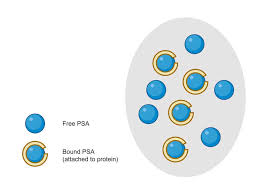
 Prostate-Specific Antigen (PSA) is a protein produced by the prostate gland.
Free PSA refers to PSA that circulates in the blood unbound to other proteins, as opposed to “total PSA” which includes both free and protein-bound forms.
The Free PSA ratio (free PSA ÷ total PSA × 100) helps distinguish between prostate cancer and benign conditions like BPH (enlarged prostate).
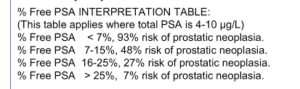
The free-to-total PSA ratio (often reported as % free PSA) helps refine prostate cancer risk assessment, especially in the “gray zone” of total PSA levels.
A lower free PSA ratio (e.g., <10–15%) suggests higher risk of prostate cancer
A higher free PSA ratio (e.g., >25%) is more associated with benign disease.
Typical use case: When total PSA is in a “gray zone” (roughly 4–10 ng/mL), the free PSA ratio helps doctors decide whether a biopsy is warranted.
Total PSA: Measures all PSA in the blood (free + bound).
Produced by prostate cells; elevated levels can indicate cancer, BPH (benign prostatic hyperplasia), prostatitis, or other conditions.
The free PSA test is most useful when total PSA is 4–10 ng/mL (or sometimes 3–10 ng/mL, depending on lab guidelines) with a negative digital rectal exam (DRE).
It helps decide whether a biopsy is warranted.
Higher % free PSA (e.g., >25%) → More likely benign condition (like BPH); lower cancer probability. Lower % free PSA (e.g., <10–15%) → Higher cancer risk; biopsy often recommended.
These are general estimates from studies; exact cutoffs vary by age, lab assay, and guidelines.
It is not a standalone diagnostic — It improves specificity but does not rule out cancer (negative biopsy still carries some risk).
Factors affecting results: Age, prostate volume, recent procedures (e.g., biopsy, catheterization), infections, or medications.
Guidelines: Often reflex-tested automatically by labs when total PSA is in the gray zone.
Not routinely used if total PSA >10 ng/mL or <4 ng/mL.
Modern approaches increasingly combine this with multiparametric MRI, PSA density, or other biomarkers (e.g., 4Kscore, PHI) for better decision-making.