
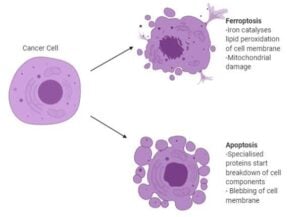
 Ferroptosis is a form of regulated cell death driven by iron and lipid peroxidation — distinct from apoptosis, necrosis, and autophagy.
It is mechanistically distinct from apoptosis and is not primarily driven by caspase activation.
Ferroptosis is an iron-dependent form of regulated cell death caused by uncontrolled peroxidation of polyunsaturated fatty-acid–containing membrane phospholipids.
Ferroptosis occurs when lipid-peroxide formation exceeds cellular antioxidant defenses, producing membrane damage and eventual rupture.
Its mechanism of Iron overload is free iron drives the Fenton reaction, generating reactive oxygen species.
Lipid peroxidation radicals attack polyunsaturated fatty acids in cell membranes producing toxic lipid peroxides that wreck membrane integrity.
Cell’s main defense is glutathione peroxidase 4 (GPX4), which neutralizes lipid peroxides using glutathione.
Glutathione depends on cystine imported by the system Xc− transporter.
When that defense fails — cystine starved, glutathione depleted, or GPX4 blocked — peroxides accumulate and the cell dies.
Ferroptosis is implicated in neurodegeneration (Parkinson’s, Alzheimer’s), ischemia-reperfusion injury (heart attack, stroke, kidney injury), and cancer — some therapy-resistant cancer cells are unusually vulnerable to ferroptosis.
Inhibitors like ferrostatin-1 and iron chelators block it in the lab.
Labile ferrous iron ((\mathrm{Fe^{2+} catalyzes reactive oxygen species formation through Fenton chemistry and can amplify lipid oxidation.
Peroxidizable membrane lipids: Acyl-CoA synthetase long-chain family member 4 (ACSL4) and lysophosphatidylcholine acyltransferase 3 (LPCAT3) enrich membranes with oxidizable polyunsaturated fatty-acid phospholipids.
Antioxidant failure: The cystine/glutamate antiporter system Xc− supplies cystine for glutathione (GSH) synthesis; glutathione peroxidase 4 (GPX4) then reduces lipid hydroperoxides.
Loss of this axis promotes ferroptosis.
Ferroptosis is being investigated in cancer, ischemia–reperfusion injury, neurodegeneration and organ injury, but the therapeutic modulation largely is preclinical or translational research rather than established routine clinical treatment.
Ferroptosis is best understood as a mechanistic research concept involving iron, membrane lipid peroxidation and failure of GPX4-centered defenses; it is not currently a standalone clinical diagnosis or routinely actionable treatment target.