
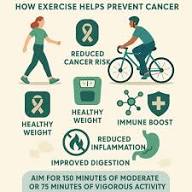
 Exercise reduces cancer risk by 10-20% for several cancer types and improves survival outcomes by 40-50% in patients with established cancer, particularly breast, colorectal, and prostate cancers.
The relationship of exercise to cancer occurs through multiple biological mechanisms and applies across the cancer continuum: That is from prevention through treatment to survivorship.
Physical activity demonstrates strong evidence for risk reduction in colorectal, breast, endometrial, kidney, bladder, esophageal adenocarcinoma, and gastric cancers.
A pooled analysis of 1.44 million adults found that high levels of leisure-time physical activity (90th vs 10th percentile) reduced risk for 13 cancer types, with hazard ratios ranging from 0.58 for esophageal adenocarcinoma to 0.90 for breast cancer.
Moderate-intensity reductions (10-20%) were observed for myeloma, colon, head and neck, rectal, bladder, and breast cancers.
Notably, even brief bursts of vigorous intermittent lifestyle physical activity provide substantial benefit.
Among nonexercising adults, just 3-4 minutes daily of vigorous activity during routine tasks (fast walking, stair climbing) was associated with meaningful cancer risk reduction, with the greatest relative benefit occurring at these minimal doses.
Physical activity was estimated to account for 2.9% of all incident cancers in the United States in 2014, with higher attributable fractions for endometrial cancer (26.7%) and colorectal cancer (6.3%).
The American Society of Clinical Oncology recommends that patients undergoing cancer treatment engage in both aerobic and resistance exercise.
Exercise during active treatment improves cardiorespiratory fitness, reduces treatment-related side effects including fatigue and enhances physical function.
Exercise mitigates adverse events such as cardiac toxicity, chemotherapy-induced peripheral neuropathy, cognitive impairment, and dyspnea.
The National Comprehensive Cancer Network recommends cancer survivors strive for at least 150 minutes of moderate-intensity or 75 minutes of vigorous-intensity activity weekly, with an optimal goal of 300 minutes moderate or 150 minutes vigorous activity, plus 2-3 sessions of strength training.
Approximately 17 MET-hours/week of physical activity over the long-term optimally reduces digestive system cancer risk.
Exercise modulates cancer biology through several pathways:
Immune enhancement: Activates natural killer cells and CD8+ T lymphocytes, promotes dendritic cell maturation, and may enhance responses to immune checkpoint inhibitors.
Metabolic regulation: Increases insulin sensitivity, lowers circulating insulin and insulin-like growth factor-1 levels.
Anti-inflammatory effects: Reduces pro-inflammatory cytokines and inhibits NF-κB signaling.
Oncogenic pathway inhibition: Suppresses PI3K/Akt/mTOR signaling crucial for tumor growth.
Metabolic competition: exercise shifts glucose metabolism away from tumors toward metabolically active tissues, potentially constraining tumor energetics.
Most cancer-exercise associations appear independent of body mass index, suggesting mechanisms beyond weight control.
Physical activity is associated with higher risk of melanoma, likely reflecting sun exposure during outdoor activity rather than a direct carcinogenic effect, and underscores the importance of sun-safe practices during physical activity.
There is also a modest increased risk of prostate cancer, though the clinical significance remains unclear.