
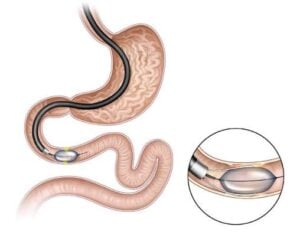
 Duodenal mucosal resurfacing (DMR) is a minimally invasive, outpatient endoscopic procedure.
It uses hydrothermal energy to ablate the inner lining (mucosa) of the duodenum, stimulating the regrowth of healthy tissue.
This metabolic reset mimics the gut hormone changes seen in bariatric surgery to improve insulin sensitivity and weight management.
A catheter is inserted down the throat and into the small intestine.
The procedure targets approximately a 10 cm segment of the duodenum.
A catheter needle is placed beneath the inner mucosal layer, followed by submucosal saline injection to lift the mucosa and create a thermal barrier protecting deeper layers.
Mucosal Lifting: A sterile fluid is injected to lift and protect the deeper muscular layers of the gut.
Hydrothermal Ablation: Hot water is used to gently burn away the top layer of the dysfunctional duodenal lining.
Regeneration: The body naturally grows a new, healthy mucosal lining within 4 to 12 weeks following the procedure.
The catheter head then delivers hydrothermal energy to ablate the dysfunctional mucosal layer.
Complete mucosal regrowth occurs within 6–12 weeks, and the regenerated tissue demonstrates characteristics more representative of healthy mucosa without the dysfunctional features seen in the original layer.
DMR primarily being evaluated in two major metabolic categories:GLP-1 “Off-Ramp” Therapy: Studies like the REMAIN-1 trial
Hghlighting DMR’s potential to help patients who have lost weight on GLP-1 medications (like tirzepatide) discontinue the drug without experiencing the typical weight rebound.
Type 2 Diabetes & Fatty Liver (MASH): DMR resets the duodenum’s enteroendocrine function—the area responsible for producing hormones like GLP-1—which helps restore natural blood sugar control, reduce insulin dependence, and lower liver fat.
DMR primarily investigated as a treatment for type 2 diabetes mellitus (T2D) and associated metabolic disease.
The duodenum has emerged as a key metabolic treatment target based on observations from bariatric surgery: bypassing or excluding the duodenum from nutrient flow elicits favorable metabolic changes, including rapid improvements in glucose homeostasis that are independent of weight loss.
Preclinical and clinical analyses have identified changes in the duodenal mucosal layer associated with dietary excess and obesity that appear prevalent among individuals with metabolic disease.
In the first-in-human proof-of-concept study, DMR reduced HbA1c by 1.2% at 6 months overall, with greater effects in the long-segment ablation group (1.4% reduction vs. 0.7% in the short-segment group).
A multicentre open-label study (n=36) demonstrated HbA1c reduction of 0.9%, improved fasting plasma glucose (−1.7 mmol/L), and decreased HOMA-IR, with effects sustained at 12 months.
Hepatic transaminases also decreased.
These improvements did not correlate with the modest weight loss observed (−2.5 kg).
The REVITA-2 randomized, sham-controlled trial showed that in the European cohort, DMR produced significantly greater reductions in HbA1c (−6.6 vs. −3.3 mmol/mol) and liver fat (−5.4% vs. 2,2%) compared with sham.
Patients with high baseline fasting glucose (≥10 mmol/L) had the most significant benefit.
When combined with a GLP-1 receptor agonist, DMR enabled 69% of insulin-dependent T2D patients to discontinue insulin at 6 months, with 53% remaining off insulin at 18 months.
Mechanistic studies suggest DMR improves both insulin sensitivity and beta-cell function.
Hepatic insulin resistance, disposition index, and insulin secretion rate all improved significantly at 3 months.
Notably, GLP-1 and GIP levels did not change, suggesting incretin-mediated pathways are unlikely to explain the glycemic improvements.
Changes in postprandial bile acid profiles with increased unconjugated and secondary bile acids) have also been observed.
Transcriptomic analysis suggests subtle changes in enteroendocrine signaling rather than gross histological alterations may underlie the metabolic benefits.
DMR has been generally well tolerated. In the multicentre study, 52% of patients had at least one adverse event, but 81% were mild.
One serious adverse event was reported.
Duodenal stenosis occurred in 3 patients in the first-in-human study but was successfully treated with balloon dilation.
A systematic review confirmed beneficial glycemic and hepatic metabolic effects with an acceptable safety profile.
Emerging Alternatives
A related technique, recellularization via electroporation therapy (ReCET), uses pulsed electric fields rather than hydrothermal energy to achieve similar duodenal mucosal ablation and has also shown promise in T2D.