
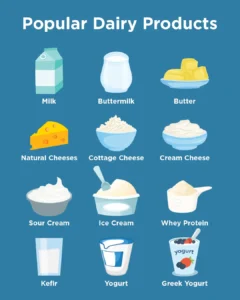
 Dairy is a nutrient-dense food, and for most people moderate intake is neutral to mildly beneficial.
Dairy products come from the milk of mammals (mostly cows, but also goats, sheep, buffalo, etc.).
Common products are milk, yogurt, cheese, butter, cream, kefir, and ice cream.
Rich in calcium, protein, and vitamins B12 and D (often added)
Fat content varies: whole, low-fat, and skim versions
Fermented items like yogurt and kefir contain probiotics
Calcium, plus vitamin D when fortified
High-quality protein
Vitamin B12, riboflavin, potassium, and phosphorus
Bone health: it supports bone density, especially in childhood and adolescence, though it’s less protective against fractures in older adults than once thought.
Heart health: fermented dairy like yogurt and cheese is neutral or slightly favorable.
Full-fat dairy has less impact on heart disease risk than its saturated fat content would predict.
Type 2 diabetes: yogurt intake is consistently linked to lower risk.
Weight: it doesn’t appear to cause weight gain in moderate amounts.
Around 65% of adults worldwide have some degree of lactose intolerance, which causes digestive discomfort but isn’t dangerous.
Milk allergy, mostly seen in children, is a separate immune reaction.
Some studies link very high milk intake to higher prostate cancer risk, but the evidence is mixed.
Butter and cream are high in saturated fat..
Most guidelines suggest 2 to 3 servings a day, such as a cup of milk or yogurt or 1.5 oz of cheese.
Milk Whole, 2%, 1%, skim, lactose-free, A2, ultra-filtered
Liquid base of most dairy; varies by fat content
Fermented / Cultured
Yogurt, kefir, buttermilk, sour cream
Live cultures; often easier to digest for some people
Cheese Soft (brie, mozzarella, ricotta, cottage), semi-soft (cheddar, gouda), har(parmesan, swiss), blue (gorgonzola)
Concentrated milk solids; protein & fat dense
Butter & Cream Butter, heavy cream, half-and-half, whipped cream High fat; used for cooking and richness
Frozen Ice cream, frozen yogurt, gelato Higher sugar; fat content varies widely Concentrated / Dried
Evaporated milk, condensed milk, milk powder, whey protein Long shelf life; used in cooking or supplements
Goat/sheep milk products, cultured butter, ghee, quark Different flavor profiles and sometimes better tolerance
Core nutrients dairy is known for: Protein — High-quality complete protein (all essential amino acids). Milk has ~8 g per cup; Greek yogurt and cheese are denser.
Calcium — Excellent source for bone health. One cup of milk typically provides ~300 mg.
Vitamin D — Often fortified in milk and some yogurts (important for calcium absorption).
Vitamin B12, riboflavin (B2), phosphorus, potassium, and iodine.
Fat — Varies greatly: whole milk ~3.5% fat, skim nearly 0%.
Dairy fat contains saturated fat plus some beneficial fatty acids (including small amounts of CLA).
Typical nutrition comparison (approximate values per 1 cup / 240 ml milk equivalent):
Product Calories Protein Fat Carbs (mostly lactose) Calcium
Whole milk 150 calories 8 g protein 8 g fat 12 g carbs 300 mg calcium
2% milk 120 calories 8 G protein 5 g fat 12 g carbs 300 mg calcium
Skim milk 80–90 calories 8 G protein 0–0.5 g fat 12 g carbs 300 mg calcium
Plain Greek yogurt (full-fat) 200–220 calories 15–20 G protein 10–15 g fat 6–9 g carbs 150–200 mg calcium
Cheddar cheese (1 oz / 28 g) 110–120 calories 7 G protein 9 g fat <1 g carbs 200 mg calcium
Cottage cheese (1 cup, low-fat) 160–180 25–28 g 2–5 g 6 g 125–150 mg
Dairy benefits: Strong source of protein + calcium + other micronutrients.
Associated with better bone health and muscle maintenance when part of a balanced diet.
Fermented dairy (yogurt, kefir) provides probiotics.
Lactose intolerance: Many people digest yogurt, hard cheese, and lactose-free milk better than regular milk, aged cheeses, and yogurt are often easier to tolerate.
Milk allergy (a reaction to milk proteins) is different from lactose intolerance and can be serious.
Saturated fat: Higher-fat dairy raises saturated fat intake; current guidelines often recommend limiting excess, though research on dairy fat specifically is mixed.
Calories: Full-fat products are more calorie-dense; choose based on your overall diet and goals.
Added sugars: Flavored yogurts, ice cream, and some processed cheeses can contain significant added sugar.
Full-fat dairy is high in saturated fat, so moderation matters for some people.
Alternatives:Soy, oat, almond, and pea milks.
**Storage:Keep refrigerated at or below 40°F (4°C).
Opened milk usually lasts about 5 to 7 days.