
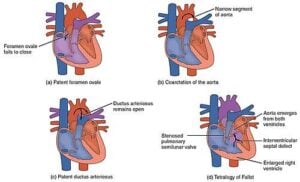
 Cyanotic congenital heart disease (CCHD) is a group of birth defects that cause a right-to-left heart shunt, forcing deoxygenated blood into the body.
This deprives tissues of oxygen, causing the hallmark bluish-tinted skin (cyanosis), shortness of breath, and feeding difficulties.
It accounts for about 25% of all congenital heart defects:the rest are acyanotic.
Common types of cyanotic defects are classically remembered by the “5 Ts”:Tetralogy of Fallot: The most common type, featuring a combination of four structural heart abnormalities.
Transposition of the Great Arteries: The aorta and pulmonary artery are switched, creating two closed-loop circulations.
Truncus Arteriosus: A single large vessel fails to divide into the aorta and pulmonary artery.
Total Anomalous Pulmonary Venous Return (TAPVR): Pulmonary veins drain into the right atrium instead of the left.
Tricuspid Atresia: The tricuspid valve is missing or underdeveloped, blocking blood flow to the right ventricle.
Diagnosis:
Routine prenatal ultrasounds or a pulse oximetry screening after birth are often the first steps in diagnosis.
If a defect is suspected, cardiologists confirm the type and severity using an echocardiogram, electrocardiogram (EKG), and occasionally chest X-rays or cardiac catheterization.
Treatment and ManagementTreatment almost always requires surgical correction or catheter-based procedures, usually performed within the first year of life.
Infants may also require temporary medication (e.g., prostaglandins) to keep connections open until surgery, or supportive therapy for heart failure.
Relative frequency among cyanotic CHDs (approximate):
Tetralogy of Fallot— most common cyanotic CHD overall, ~5–10% of all CHD Transposition of the Great Arteries (TGA)— ~5% of all CHD; most common cause of cyanosis in the *newborn* period Tricuspid atresia— ~1–3% Truncus arteriosus— ~1–2% Total Anomalous Pulmonary Venous Return (TAPVR)— ~1% Hypoplastic left heart syndrome— ~1–3% (also cyanotic) Ebstein’s anomaly— <1%