
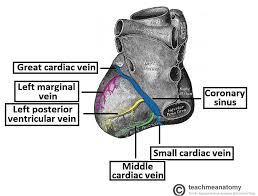
 The coronary sinus is the largest vein of the heart, serving as the primary collector of deoxygenated blood from the heart muscle (myocardium) and returning it to the right atrium.
The coronary sinus is a wide venous channel located on the posterior aspect of the heart, specifically in the left atrioventricular groove (coronary sulcus) between the left atrium and left ventricle.
Dimensions: It typically measures 3 to 5 cm in length and approximately 1 cm in diameter, although these measurements vary widely among individuals.
Drainage: It empties into the posteroinferior part of the right atrium, situated between the opening of the inferior vena cava and the tricuspid valve.
The coronary sinus receives deoxygenated blood from several major cardiac veins: Great cardiac vein: Drains the anterior and lateral portions of both ventricles. Middle cardiac vein: Drains the posterior part of the interventricular septum. Small cardiac vein: Drains the right atrium and right ventricle. Posterior vein of the left ventricle: Drains the diaphragmatic surface of the left ventricle. Oblique vein of the left atrium: Also known as the vein of Marshall. Valves Thebesian Valve: A semicircular fold of endocardium often found at the opening of the coronary sinus into the right atrium. Valve of Vieussens: Marks the transition point where the great cardiac vein becomes the coronary sinus.
The coronary sinus is a critical landmark and access point for several advanced cardiac procedures: Cardiac Resynchronization Therapy (CRT): It serves as a conduit for placing a pacing lead to stimulate the left ventricle.
Electrophysiology Studies: Wire electrodes are inserted into the sinus to map and diagnose irregular heart rhythms (arrhythmias).
Retrograde Cardioplegia: During open-heart surgery, it can be used to deliver cardioplegic solutions to temporarily stop the heart.
Diagnostics: It can be evaluated via Cardiac CT or MRI to detect anomalies like a Persistent Left Superior Vena Cava (PLSVC) or Unroofed Coronary Sinus, which can cause heart failure or blood clots if left untreated.