
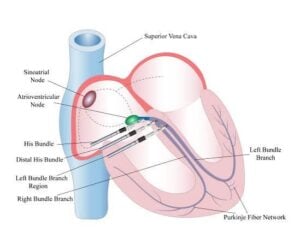
 Conduction system pacing (CSP) is an advanced method of cardiac pacing that stimulates the heart’s natural electrical wiring to restore synchronized, physiological ventricular contraction.
Conduction system pacing (CSP) is an umbrella term for pacing techniques that directly stimulate the native His–Purkinje network to achieve physiologic ventricular activation, encompassing two modalities: His bundle pacing (HBP) and left bundle branch area pacing (LBBAP).
His Bundle Pacing (HBP): Paces the specialized conduction tissue directly at the Bundle of His, yielding a narrow QRS and true physiological activation, though it can feature higher or rising pacing thresholds.
His bundle pacing (HBP) is the most physiologic mode because it preserves native left and right ventricular activation.
It is indicated for AV nodal and intra-Hisian conduction disease with symptomatic bradycardia, and can correct left bundle branch block (LBBB) when the diseased fibers lie within the His bundle.
Left Bundle Branch Area Pacing (LBBAP): Involves deep septal screw-in lead placement to capture the left bundle branch network; it provides lower, stable pacing thresholds and higher procedural success.
Compared with conventional right ventricular pacing (RVP)—which produces slow, dyssynchronous myocyte-to-myocyte activation and is linked to pacing-induced cardiomyopathy, atrial fibrillation, heart failure, and increased mortality.
CSP restores more synchronous biventricular activation and is emerging both as an alternative to RVP for bradycardia and as an alternative to biventricular CRT in selected heart failure patients.
Hybrid Strategies (HOT-CRT / LOT-CRT): Combines conduction system pacing with traditional coronary venous or right ventricular pacing to manage complex heart failure and severe conduction delays.
Physiological Activation: Avoids the unnatural, dyssynchronous activation patterns caused by traditional right ventricular apical pacing.
Heart Failure Protection: Improves left ventricular ejection fraction (LVEF), decreases heart failure hospitalizations, and reduces pacing-induced cardiomyopathy compared to conventional right ventricular pacing.
CRT Alternative: Serves as an effective alternative or upgrade to biventricular pacing (cardiac resynchronization therapy) for patients with bundle branch blocks.
Requires specialized delivery sheaths, precise mapping, and real-time electrical monitoring during implantation.
Potential for high capture thresholds (especially in HBP), lead dislodgement, and occasional septal perforation or lead adhesion during LBBAP.
Its limitations are challenging implantation, high and sometimes unstable capture thresholds, low R-wave sensing, and a higher reintervention rate from lead dislodgement or threshold rise.
Left bundle branch area pacing (LBBAP) requires advancing a lead across the interventricular septum to the left subendocardial left bundle or its fascicles.
It has become the dominant CSP approach owing to a larger anatomical target, higher success rates, shorter procedure times, lower and more stable thresholds, and robust ventricular sensing. It also corrects LBBB caused by disease below the His bundle.
Capture is usually nonselective (conduction system plus local myocardium).
CSP is more physiologic than RVP, yielding shorter paced QRS, preservation of LVEF, and lower rates of mitral/tricuspid regurgitation, and observational and smaller randomized data suggest better clinical and echocardiographic outcomes than biventricular CRT in patients needing resynchronization.
The MELOS registry reported high LBBAP success rates (92.4% for bradycardia, 82.2% for heart failure), with an overall complication rate of 8.3%—nearly half being acute septal perforation into the LV, which is readily recognized and managed by lead withdrawal and repositioning without apparent long-term adverse consequences.
Larger randomized trials are still needed to confirm whether CSP should become the new gold standard, particularly for CRT and patients with anticipated high pacing burden (>20%).
Would you like to explore the specific indications for LBBAP versus biventricular CRT in heart failure?