
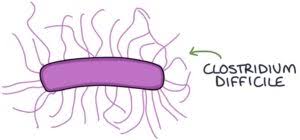
 Clostridioides difficile (formerly Clostridium difficile) is a gram‑positive, spore‑forming, obligate anaerobic bacillus and the leading identifiable cause of antibiotic‑associated diarrhea and colitis worldwide.
It typically causes disease when normal colonic microbiota are disrupted most often by antibiotics, allowing colonization and toxin production that range clinically from asymptomatic carriage to fulminant, life‑threatening colitis with toxic megacolon and shock.
CD It’s a gram positive spore, forming anaerobic bacterium that can produce toxins.
After ingestion CD spores, which can be found in healthcare institutions and homes of healthy people colonize the intestine.
In healthy individuals gut bacteria, bile acid metabolism, and immune system can suppress spore germination.
With changes in the gut bacteria from antibiotics CD overgrowth and toxin production can convert asymptomatic colonization into symptomatic infection.
Toxins A/Bbind to colonic epithelium receptors and cause inflammation and cell death leading to diarrhea and colitis.
Fecal toxin levels correlate with increased disease, severity, recurrence, and mortality.
Symptoms of C. difficile infection range from mild infection 60 to 80% of cases with diarrhea to fulminant colitis requiring ICU admission in 6% of cases, colectomy , and death in approximately 2%.
C. difficile is a spore‑forming, gram‑positive rod whose spores persist in the environment and resist many disinfectants, enabling healthcare‑associated spread via the fecal–oral route.
Spores survive gastric acid and germinate in the intestine in response to bile acids.
Pathogenic strains produce toxins A (TcdA, enterotoxin) and B (TcdB, cytotoxin), glucosyltransferases that inactivate Rho GTPases, disrupt the actin cytoskeleton, increase permeability, and induce inflammation, leading to diarrhea and pseudomembranous colitis.
Hypervirulent NAP1/ribotype 027 strains are linked to higher toxin production, severe disease, and outbreaks.
C. difficile is the most common cause of healthcare‑associated infectious diarrhea in the U.S., with substantial morbidity, mortality, and cost; hundreds of thousands of cases and tens of thousands of deaths were estimated in a single recent year. Incidence of community‑associated infection has also risen, including in individuals without recent hospitalization.
Major risk factors include for CD infection
Recent or current antibiotic exposure (especially fluoroquinolones, cephalosporins, clindamycin, and broad‑spectrum penicillins).
Advanced age, significant comorbidities, or immunosuppression.
Recent hospitalization, long‑term care or nursing home residence, GI surgery, proton pump inhibitor use, and prior C. difficile infection.
Typical infection presents with watery diarrhea, abdominal cramping, and sometimes low‑grade fever and leukocytosis after or during antibiotic therapy.
Severe disease may show marked leukocytosis, acute kidney injury, abdominal distention, and signs of sepsis.
Complications include pseudomembranous colitis, toxic megacolon, perforation, and fulminant colitis with high mortality.
Asymptomatic colonization is common in infants and occurs in a minority of healthy adults; treatment of asymptomatic carriers is not recommended.
Diagnosis
Compatible symptoms Laboratory evidence of toxigenic C. difficile or its toxins in stool. Common testing strategies include: Enzyme immunoassays for toxins A/B, often combined with glutamate dehydrogenase (GDH) screening as part of multistep algorithms. Nucleic acid amplification tests (e.g., PCR) for toxin genes, which are highly sensitive but may detect colonization rather than active disease if used indiscriminately.
Treatment and Prevention
Initial management includes stopping the inciting antibiotic when feasible and avoiding antimotility agents.
For non‑fulminant initial episodes, oral vancomycin or fidaxomicin is recommended as first‑line therapy; metronidazole is now generally reserved for limited situations.
Recurrent infection may be treated with tapered or pulsed oral vancomycin regimens, fidaxomicin, or adjunctive bezlotoxumab; fecal microbiota transplantation is used in selected patients with multiple recurrences.
Infection prevention relies on: Rigorous hand hygiene with soap and water, contact precautions, and environmental cleaning with sporicidal agents in healthcare settings.
Antibiotic stewardship to limit unnecessary or high‑risk antibiotic exposure.
The organism’s ability to form highly resilient spores, which are resistant to heat, acid, and many disinfectants, allows it to persist in hospital environments and on surfaces for extended periods, facilitating nosocomial transmission and recurrence.
Upon ingestion, C. difficile spores survive gastric acidity and germinate in the intestine, particularly when the normal gut microbiota is disrupted, most commonly due to antibiotic exposure.
Vegetative cells then colonize the colon, where they may exist as part of the normal flora in a minority of healthy adults and in a majority of infants, who are typically asymptomatic due to the absence of toxin receptors in the immature gut.
Colonization resistance is primarily mediated by the intact gut microbiota, which competes for nutrients and produces secondary bile acids that inhibit C. difficile outgrowth.
Antibiotic-induced dysbiosis, advanced age, immunosuppression, and comorbidities facilitate colonization and subsequent infection.
TcdA and TcdB enter colonocytes via receptor-mediated endocytosis, undergo autoproteolytic cleavage, and release the glucosyltransferase domain into the cytosol, where they inactivate Rho family GTPases.
This leads to disruption of the actin cytoskeleton, loss of epithelial barrier integrity, cell rounding, and ultimately cell death.
The direct effects of these toxins result in increased intestinal permeability, fluid secretion, and recruitment of neutrophils, producing a characteristic inflammatory response.
The clinical spectrum ranges from mild diarrhea to severe pseudomembranous colitis, toxic megacolon, and death.
C. difficile’s metabolic adaptation to the inflamed gut, include utilization of host-derived nutrients released during inflammation and production of metabolic by-products such as p-cresol, which further promotes dysbiosis and persistence.
Not all individuals colonized with toxigenic C. difficile develop symptomatic infection; asymptomatic colonization is common, particularly in infants and hospitalized adults, and may be influenced by host factors such as anti-toxin antibodies and the integrity of the gut microbiota.
Clostridioides difficile infection remains a significant global public health concern, with marked regional variation in incidence, strain prevalence, and outcomes.
The incidence of healthcare-associated CDI has decreased, but community-associated CDI has risen and now accounts for 35–48% of cases in the United States.
The global burden of CDI has increased over the past three decades, with the highest incidence and fastest growth observed in high-income countries.
Both the age-standardized rate of disability-adjusted life years (ASR-DALYs) and age-standardized death rates (ASDRs) attributable to CDI have risen worldwide, with an average annual percentage change (AAPC) of approximately 2% for both metrics from 1990 to 2021.
High SDI countries, including the United States, Canada, and Western European nations, have consistently reported the highest incidence and fastest growth rates of CDI.
In contrast, low SDI regions have experienced either stable or declining rates, although some low-middle SDI countries, such as South Africa, have reported a heavy disease burden.
The United States has the highest reported CDI incidence globally.
In Europe, CDI incidence has generally declined since the mid-2000s, particularly in the United Kingdom, where rates fell by more than 75% from 2007 to 2015, likely due to successful antimicrobial stewardship, mandatory infection control measures, and public reporting of CDI cases.
In Asia, CDI rates are now comparable to those in Europe and North America, with a pooled prevalence of 14.8% among patients with diarrhea and an estimated 5.3 episodes per 10,000 patient-days.
The most important and well-established risk factor for CDI is exposure to antibiotics, which disrupt the normal gut microbiota and facilitate colonization and overgrowth of C. difficile.
Broad-spectrum antibiotics: clindamycin, fluoroquinolones, cephalosporins, and carbapenems, are particularly implicated, but nearly all antibiotics have been associated with increased risk.
The risk of CDI is proportional to the duration and intensity of antibiotic exposure, with the highest risk occurring within the first month after cessation and persisting for up to three months.
Advanced age, especially over 65 years, is a significant risk factor, with older adults experiencing higher incidence, severity, and mortality.
The presence of comorbidities, such as chronic kidney disease, cardiac disease, inflammatory bowel disease (IBD), and immunosuppression, further increases susceptibility to CDI.
Recent gastrointestinal surgery, exposure to antineoplastic agents, and prior CDI events are additional risk factors.
C. difficile is transmitted primarily via the fecal-oral route, with spores serving as the infectious form.
These spores are highly resistant to heat, acid, and many disinfectants, allowing them to persist in the environment for extended perIODS.
Transmission occurs through direct contact with contaminated surfaces, hands, or fomites, and is facilitated by inadequate hand hygiene and environmental cleaning.
In healthcare settings, transmission is most commonly associated with contact with symptomatic carriers, contaminated hospital environments, and, to a lesser extent, asymptomatic carriers.
Asymptomatic carriers are reservoirs, as they can shed spores and contribute to environmental contamination without manifesting symptoms.
The prevalence of asymptomatic colonization with C. difficile during hospitalization can be as high as 20–25% in adults and children in some centers, with approximately 8% of patients colonized at the time of hospital admission.
Prevention of exposure and colonization is essential for CDI prevention, underscoring the importance of targeting both symptomatic and asymptomatic reservoirs.
The cardinal symptom of CDI is new-onset, unexplained diarrhea, typically defined as three or more unformed stools within a 24-hour period in the absence of other causes such as laxative use.
The diarrhea is usually watery and may be accompanied by abdominal pain, cramping, fever, nausea, and anorexia.
In severe cases, patients may develop signs of colonic inflammation such as abdominal distension, ileus, or toxic megacolon, and systemic features including leukocytosis, acute kidney injury, and lactic acidosis.
Pseudomembranous colitis, characterized by the presence of yellow-white plaques on the colonic mucosa, is pathognomonic but not universally present and is most often identified via endoscopy.
Fulminant CDI, occurs in less than 10% of cases, and may present with shock, ileus, or multi-organ failure.
Rare/atypical clinical presentations include: absence of diarrhea, small bowel involvement, intussusception, rectal prolapse, and extraintestinal manifestations such as bacteremia, abscesses, wound infections, musculoskeletal involvement, and device-related infections.
Extraintestinal CDI is rare, accounting for less than 0.2% of all CDI cases.
Extraintestinal CDI is associated with high morbidity and mortality, particularly in patients with advanced age, malignancy, or severe comorbidities.
Systemic effects of C. difficile toxins, including cardiac, renal, and neurologic impairment, have been found in fulminant disease.
CDI complications: recurrence (10–30% after initial episode, and higher with each recurrence. severe colitis/fulminant CDI (toxic megacolon, bowel perforation, peritonitis, multiorgan failure) colectomy (0.3–1.3% endemic, up to 6.2% epidemic) renal failure sepsis/septic shock, increased hospitalization and transfer to long-term care and mortality (4.5–5.7% endemic, 6.9–16.7% epidemic 12,000–30,000 deaths/year in the US
CDI is also associated with marked reduction in health-related quality of life, persistent physical, mental, and social effects, and substantial economic burden ($3,006–$21,000 per episode; $1.0–4.9 billion annual US hospital costs).
Diagnosis of CDI is based on the presence of compatible clinical symptoms of primarily diarrhea and laboratory evidence of toxigenic C. difficile in the stool.
It is recommend testing only in patients with unexplained and new-onset diarrhea (≥3 unformed stools in 24 hours) and not in those with formed stools, except in cases of ileus or toxic megacolon where stool may not be available.
In children, testing is generally reserved for those older than 2 years with prolonged diarrhea and risk factors, as asymptomatic colonization is common in infants.
No single laboratory test is sufficient for the diagnosis of CDI,
Guidelines advocate for a multi-step algorithm to maximize sensitivity and specificity for CDI.
The most widely recommended approach: initial screening with a nucleic acid amplification test (NAAT; e.g., PCR) or enzyme immunoassay (EIA) for glutamate dehydrogenase (GDH), followed by a confirmatory test for free toxins in the stool (toxin A/B EIA) if the screening test is positive.
NAAT and GDH are highly sensitive but lack specificity, as they detect both toxigenic and non-toxigenic strains and cannot distinguish between colonization and active infection.
The presence of free toxin correlates better with clinical disease and severity.
Toxigenic culture and cell cytotoxicity neutralization assay are considered gold standards but are slow and labor-intensive, making them impractical for routine clinical use.
Only unformed stool should be tested.
In patients with ileus or toxic megacolon who cannot produce stool, perirectal swabs for NAAT may be considered.
Routine repeat testing or testing for cure is not recommended, as patients may continue to shed C. difficile after resolution of symptoms.
The management of CDI is guided by the most recent recommendations:
The preferred first-line therapy is oral fidaxomicin, dosed at 200 mg twice daily for 10 days.
Fidaxomicin is associated with lower recurrence rates compared to oral vancomycin (125 mg four times daily for 10 days), with similar rates of initial clinical cure.
Metronidazole is no longer recommended as first-line therapy due to inferior efficacy and higher recurrence rates, though it may be considered in select low-risk patients where other agents are unavailable.
For severe CDI, oral vancomycin (125 mg four times daily for 10 days) or fidaxomicin (200 mg twice daily for 10 days) remains the standard.
In fulminant CDI, defined by hypotension, shock, ileus, or megacolon, the recommendation is high-dose oral vancomycin (500 mg every six hours) combined with intravenous metronidazole (500 mg every eight hours).
For patients with ileus, rectal administration of vancomycin (500 mg every six hours as an enema) may be beneficial.
Early surgical consultation is advised for fulminant cases, given the risk of rapid deterioration and the potential need for colectomy.
Recurrence occurs in approximately 20–25% of patients after initial therapy, with risk factors including advanced age, immunosuppression, prior CDI episodes, and infection with hypervirulent strains.
For the first recurrence fidaxomicin as the preferred recommended agent, with vancomycin as an alternative.
Extended fidaxomicin regimens (200 mg twice daily for five days, then once daily on alternate days for days 7–25) and vancomycin tapering schedules (e.g., 125 mg four times daily for 10–14 days, then gradually reduced over several weeks) are supported by clinical data.
For patients with multiple recurrences (second or subsequent), fecal microbiota transplantation (FMT) is recommended.
FMT restores gut microbial diversity and has demonstrated cure rates exceeding 85% in multiply recurrent CDI, compared to 40–50% with antibiotics alone.
FMT is generally reserved for patients who have failed at least two courses of standard therapy.
Newer standardized microbiota-based therapies, such as Fecal Microbiota, live-jslm (Rebyota) and Fecal Microbiota Spores, live-brpk (Vowst), have recently been approved for prevention of recurrent CDI and offer alternatives to conventional FMT.
Standardized live biotherapeutic products (LBPs), such as Fecal Microbiota Spores, live-brpk (Vowst) and Fecal Microbiota, live-jslm (Rebyota), are oral and rectal formulations, restore gut microbial diversity and are indicated for the prevention of recurrent CDI.
These agents have demonstrated significant reductions in recurrence rates in phase III trials, such as ECOSPOR III (SER-109) and PUNCH CD3 (RBX2660), and offer a standardized, scalable alternative to conventional FMT.
Bezlotoxumab, a monoclonal antibody targeting C. difficile toxin B, is approved for prevention of recurrent CDI in high-risk adults when used in conjunction with standard-of-care antibiotics.
Guidelines recommend bezlotoxumab for patients with risk factors for recurrence, such as age ≥65 years, immunocompromised status, severe CDI, or infection with hypervirulent strains.
Monoclonal antibody therapy has also advanced, with bezlotoxumab approved for the prevention of recurrent CDI in high-risk adults.
Bezlotoxumab is administered as a single intravenous infusion (10 mg/kg) during antibiotic therapy.
Discontinuation of inciting antibiotics, when clinically feasible, is a critical component of CDI management, as ongoing exposure increases the risk of recurrence.
Supportive care, including fluid and electrolyte management, is essential, particularly in severe and fulminant cases.
The role of probiotics in primary or secondary prevention remains controversial, with insufficient evidence to support routine use.
In immunocompromised patients fidaxomicin is recommended as first-line therapy for both initial and recurrent CDI, with vancomycin as an alternative.
FMT may be considered after three total CDI episodes, but caution is warranted due to the risk of transmitting enteric pathogens.
In pediatric populations, oral vancomycin is now considered first-line therapy for initial CDI, with fidaxomicin as an effective alternative, particularly for recurrent disease.
FMT is supported for multiply recurrent cases in children who have failed standard antibiotic therapy.
CDI prevention relies on antibiotic stewardship and infection control, with unique challenges posed by the predominance of community-associated CDI and the high prevalence of colonization in young children.
It is recommended that all patients with suspected or confirmed CDI be placed on contact precautions, ideally in a single-patient room, to minimize the risk of patient-to-patient transmission.
Healthcare personnel must don gowns and gloves upon entry to the patient’s room and remove them prior to exit, followed by appropriate hand hygiene.
Hand hygiene with soap and water is essential.
Alcohol-based hand sanitizers are ineffective against C. difficile spores and do not remove them from the hands.
Environmental cleaning and disinfection with a 1:10 dilution of sodium hypochlorite/household bleach or other EPA-approved sporicidal agents is critical, particularly in outbreak or hyperendemic settings.
Cleaning of patient rooms after discharge is essential to reduce environmental contamination.
Antibiotic exposure is the primary modifiable risk factor for CDI.
Programs that restrict the use of high-risk antibiotics and minimize unnecessary antimicrobial use have been shown to reduce CDI rates in both outbreak and non-outbreak settings.
Screening for asymptomatic colonization is not currently recommended as the degree of environmental contamination and transmission risk from colonized individuals is lower than from those with active infection.
Decolonization of asymptomatic carriers is not recommended, as there is no evidence that such strategies are effective in reducing transmission or preventing infection.
Microbiome restoration is a transformative approach for recurrent CDI.
Fecal microbiota transplantation (FMT) has demonstrated superior efficacy compared to antibiotics alone, with cure rates exceeding 85% in multiply recurrent cases.
Several investigational agents are in late-stage development.
Bacteriophage-based therapies, bacteriocins, and small-molecule immunomodulators are also under investigation, offering targeted, microbiome-sparing strategies.
Vaccine development for CDI is an area of active research.
These vaccines target the major C. difficile toxins (TcdA and TcdB) and aim to induce protective immunity in at-risk populations, such as older adults and those with frequent healthcare exposure.
Emerging prevention strategies include the use of live biotherapeutic products for secondary prophylaxis, particularly in patients with a history of recurrent CDI.
Probiotics have been used for primary prevention, but evidence remains mixed and major guidelines do not recommend routine use.