
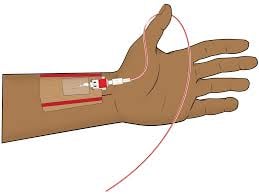
 Arterial catheterization is the insertion of a thin catheter into an artery, primarily used in critical care and surgical settings for continuous blood pressure monitoring and frequent arterial blood sampling.
Arterial catheters offer valuable, real-time data that is more accurate than non-invasive methods, especially for critically ill patients.
Arterial lines provides beat-to-beat monitoring of systolic, diastolic, and mean arterial pressures, which is crucial when a patient has unstable blood pressure or is receiving vasoactive medications that need precise titration.
It allows one to repeatedly draw arterial blood samples (e.g., for blood gas analysis to check oxygen and carbon dioxide levels) without having to repeatedly stick the patient with a needle.
Information from the catheter helps guide treatment, such as adjusting oxygen therapy or mechanical ventilator settings, or evaluating the effects of cardiovascular drugs.
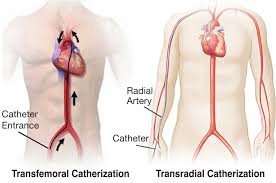
In the context of cardiac catheterization, a catheter is guided to the heart to identify blockages and, if necessary, treat them immediately with procedures like angioplasty and stent placement.
Common Insertion Sites:
Radial artery is the most common and preferred site due to its superficial location, ease of access, and a low risk of severe complications because of the hand’s collateral circulation, as supplied by the ulnar artery.
Femoral artery is often used for longer procedures, in urgent situations, or when other arteries are difficult to access.
As a larger artery, it carries a slightly higher risk of bleeding and infection compared to the radial site.
The ulnar, brachial, axillary, dorsalis pedis (foot), and posterior tibial arteries can also be used as secondary options.
While generally safe, arterial catheterization is an invasive procedure and carries potential risks:
Bleeding at the insertion site is the most common issue.
Infection: there is a risk of bacteria traveling into the bloodstream, which increases the longer the catheter is in place.
Thrombosis
Vessel Damage: In rare cases, the artery wall may be damaged, leading to complications like pseudoaneurysm formation or an arteriovenous fistula.
Nerve Damage or Ischemia: Damage to adjacent nerves or a lack of blood flow from ischemia to the extremity, which is a rare but serious risk.
Among patients with shock, results were death from any cause at day 28 indicated that management without early arterial catheter insertion was non-inferior to early catheter insertion (EVERDAC trial group).
Rtecent trial suggest shifting practice away from knee jerk invasive approach to blood pressure monitoring in patient with shock.