
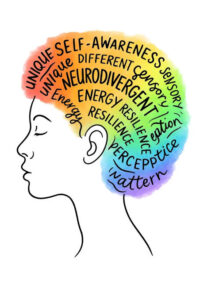
 Neurodivergent describes people whose brains work in ways that differ from what’s considered typical — in how they think, learn, process sensory input, or interact socially.
Neurodivergent refers to an individual whose brain diverges from the neurotypical majority.
Common examples people include under this umbrella:
Autism spectrum ADHD Dyslexia, dyscalculia, dyspraxia Tourette syndrome Some forms of intellectual disability or giftedness Certain mental-health or processing differences (depending on context) OCD
Some people also include mental health conditions like bipolar disorder.
It’s a social/identity term, not a clinical diagnosis.
It frames neurological differences as natural human variation rather than pure deficits or disorders that always need fixing.
The term is usually applied when the variation significantly affects how someone experiences the world, learns, socializes, or works.
It is a descriptive identity/term, not a formal medical diagnosis.
Strengths such as pattern recognition, hyperfocus, creative thinking, intense interests, and challenges of sensory sensitivity, executive-function differences, social communication differences, often coexist.