
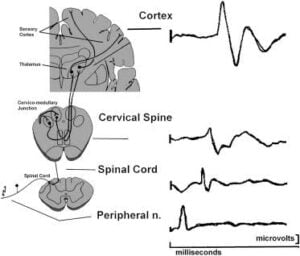
 Somatosensory evoked potentials (SSEPs) are electrophysiologic tests that assess the integrity of the ascending somatosensory pathways by stimulating a peripheral nerve and recording the response along the pathway up to the cortex.
A somatosensory evoked potential (SEP) is an electrical signal recorded from the nervous system in response to touch, pressure, or nerve stimulation and is used to measure how well sensory signals travel from the body to the brain.
SSEPs evaluate conduction from a stimulated sensory nerve through the spinal cord, brainstem, thalamus, and somatosensory cortex.
They are most useful for detecting dysfunction in the dorsal column–medial lemniscus system rather than the motor pathways.
SSEPs are used to supplement neurologic examination and imaging when the diagnosis is uncertain, and they are also widely used for intraoperative monitoring of spinal cord function during surgery.
SSEPs can help in both central and peripheral nervous system disorders, especially when structural imaging does not fully explain symptoms.
A present response generally supports intact pathway conduction, while an absent or delayed response may suggest pathology, though interpretation depends on technique, stimulation site, and lab-specific normative values.
A peripheral nerve is stimulated-commonly median nerve at the wrist, or posterior tibial nerve at the ankle, with small electrical pulses
Electrodes placed along the pathway over the nerve, spinal cord, brainstem, and scalp and record the resulting signal as it travels upward.
The signal’s latency and amplitude are measured at each point
Median nerve SSEP testing is often used to monitor dorsal column function during spinal surgery, where loss or marked attenuation of cortical responses can warn of potential injury.
SSPEs detect damage or dysfunction anywhere along the sensory pathway (peripheral nerve → spinal cord → brainstem → cortex).
Intraoperative monitoring during spine or brain surgery, to find nerve/cord injury in real time
Diagnosing conditions like multiple sclerosis, spinal cord injury, or peripheral neuropathy.
Prognosis after brain injury (e.g., in coma, absent cortical SEPs can indicate poor outcome)
Delayed latency-often demyelination
Reduced amplitude or absent response-axonal loss or a conduction block
Comparing sides can localize where along the pathway the problem is.