
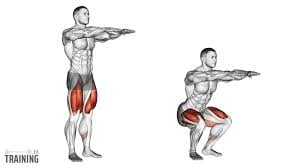
 Bodyweight squats are a highly effective exercise that builds lower-body strength, mobility, and cardiovascular endurance.
Body squats offer broad medical value spanning musculoskeletal strengthening, cardiovascular conditioning, metabolic health, bone preservation, fall prevention, and rehabilitation.
They are among the most accessible resistance exercises, requiring no equipment and adaptable to a wide range of fitness levels and clinical populations.
They primarily target the quadriceps and glutes while also engaging the hamstrings and core.
Starting Stance:
Planting the feet shoulder-width apart with toes pointing slightly outward.
The movement pushes the hips back and bending the knees.
Keep the chest up, maintaining a neutral spine, and knees track in line with your toes.
Lowering until thighs are parallel to the floor, or go as low as individual mobility allows without letting the lower back round.
The Ascent: Push evenly through the midfoot and heels to return to a standing position, squeezing your glutes at the top.
Variations for Progression
Paused Squats: Add a 2–3 second pause at the bottom of the squat to eliminate momentum and increase time under tension.
Jump Squats: Explode upward off the floor at the top of the movement to build explosive power and elevate your heart rate.
Pistol Squats: A challenging single-leg squat variation that builds high levels of unilateral strength and balance.
Common mistakes: Heels rising off the floor Knees caving in Leaning too far forward
Bodyweight squats are valuable because they build lower-body strength, improve mobility, and can help with calorie burn and blood sugar control when done regularly.
They also require no equipment, so they’re an easy exercise to fit into a routine.
A simple way to use them is to do a few sets during the day rather than one huge session: 10 squats every 45 minutes can be more metabolically useful than doing them all at once in some contexts.
Bodyweight squats recruit over 200 muscles, including the quadriceps, hip extensors, hip adductors/abductors, and triceps surae, along with significant isometric trunk stabilizer activation.
Bodyweight squat training produced comparable gains in knee extensor/flexor strength and muscle thickness to barbell back squats, though barbell training was more effective for reducing body fat percentage.
In older adults, home-based bodyweight squat training significantly improved sit-to-stand performance and leg press strength regardless of squat depth.
Squats are not purely anaerobic.
During multiple sets, oxygen consumption can reach up to ~100% of VO2max in trained individuals, demonstrating substantial cardiorespiratory demand.
Among bodyweight squat variations, jumping squats elicit the highest heart rate response (peak ~165 bpm) and greatest muscle deoxygenation.
Progressive resistance training incorporating squats is associated with improved femoral neck BMD in individuals at increased fracture risk.
In postmenopausal women with osteopenia/osteoporosis, a 12-week squat-based maximal strength training program increased lumbar spine and femoral neck bone mineral content by 2.9% and 4.9%, respectively.
The American College of Sports Medicine notes that resistance exercise effectively increases bone mass and may prevent, slow, or reverse osteoporosis-related bone loss.
Fall Prevention and Functional Mobility: Progressive resistance training programs are associated with improved performance on the Timed Up and Go test and balance/functional exercises reduce fall rates by 24% in community-dwelling adults.
Squats closely mimic daily functional movements (sitting, standing, stair climbing), making them particularly relevant for preserving independence in older adults.
Rehabilitation Applications
Squats are used in rehabilitation for ACL injuries, patellofemoral pain syndrome, and knee osteoarthritis.
Biomechanical analysis shows that squats in the 0-50° knee flexion range generate minimal joint forces, making this range appropriate for many rehabilitation patients.
Static low-angle squats have been shown to reduce intra-articular inflammatory cytokines and improve function in knee osteoarthritis.
Squats do not compromise knee stability and may enhance it when performed correctly.
Improper squat forms-particularly excessive forward trunk lean and anterior knee displacement can increase compressive and shear forces on the knee.
Concerns about deep squats causing degenerative joint changes are largely unfounded when proper technique is maintained; in fact, half and quarter squats with supramaximal loads may pose greater long-term risk to knee and spinal joints than deep squats with appropriate loading.
Higher muscular fitness from resistance training is associated with improved body composition, blood glucose levels, insulin sensitivity, and blood pressure in prehypertensive/stage 1 hypertensive individuals, with potential effectiveness in preventing and treating metabolic syndrome.