
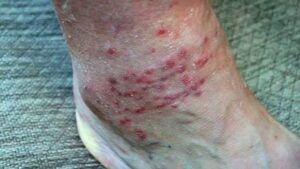
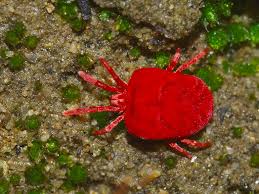
 Chiggers are the larval (immature) stage of certain mites in the family Trombiculidae that parasitize skin and cause intensely pruritic papules after outdoor exposure in grassy or brushy areas.
Chiggers are larval mites whose bites cause intense itching and small red papules (trombiculiasis).
They do not burrow into skin or suck blood.
They commonly affect areas under tight clothing (waistline, ankles, groin) and are most frequent in summer–fall; symptoms usually improve within days but can persist up to two weeks.
They inject enzymes that digest superficial skin cells, then feed on the liquefied tissue and drop off after a short meal.
Chiggers are microscopic, six‑legged larvae of mites that later mature into eight‑legged, free‑living nymphs and adults.
Chiggers are arachnids related to ticks and spiders.
In North America common species are in the genera Eutrombicula and Trombicula.
Chiggers live in vegetation‑shaded soil, tall grass, weeds, and along woodland edges, often in warm, humid areas near water.
Chiggers activity is greatest from late spring through summer and early fall, when temperatures are warm enough for egg laying and larval emergence.
Bites and clinical features of chiggers: Larvae attach to thin or constricted skin at waistband, sock line, groin, axilla, and then inject proteolytic saliva and feed for up to several days before dropping off.
This induces a host reaction producing intensely itchy, erythematous papules or wheals, sometimes with a central red dot corresponding to the stylostome feeding tue.
Chiggers do not burrow into the skin and are not still present inside the lesions; they remain on the surface attached at pores or hair follicles.
They also do not drink blood; their feeding is on digested epidermal tissue, so removing them early reduces exposure but does not change the delayed hypersensitivity itch that develops later.
Symptomatic management typically includes: topical corticosteroids, oral antihistamines, cool compresses, avoidance of scratching to limit secondary infection, and calamine or menthol for itch.
Chigger lesions are self‑limited.
Nail polish/Vaseline to suffocate mites larvae are not helpful, as chiggers rarely remain attached beyond 48 hours.
Prevention focuses on avoiding infested areas, using long clothing, applying repellents (such as DEET or permethrin‑treated garments), and showering with soap soon after exposure to remove unattached larvae.
Typical cases are diagnosed clinically after outdoor exposure with grouped itchy papules; no tests are needed.
Itching typically resolves in 2–3 days but may last up to two weeks; overall prognosis is excellent and self-limited.
Rare complications include secondary bacterial infection and summer penile syndrome in boys (penile edema/itch, usually resolving in ~4 days).