
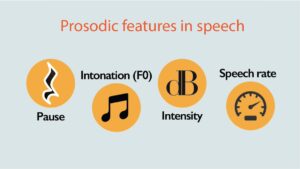
 Prosody refers to the patterns of rhythm, stress, and intonation in spoken language – essentially the melody and rhythm of speech that goes beyond the literal words themselves.
Prosody refers to the music of speech,that beyond individual sounds has features that convey meaning, emotion, and structure without changing the words themselves.
The main elements of prosody include: Intonation – the rise and fall of pitch in speech, which helps convey meaning, emotion, and sentence type- questions vs. statement.
Stress with emphasis on syllables or words: the emphasis placed on certain syllables or words, which can change meaning- e.g. “PREsent” the noun vs. “preSENT” the verb.
Rhythm and timing (pauses, tempo, syllable duration):Rhythm – the timing and pacing of speech, including the duration of sounds and pauses
Tempo – how quickly or slowly someone speaks
Loudness (volume variations)
Voice quality (e.g., breathy, creaky)
Prosody plays crucial roles in communication.
Prosody helps convey emotions, indicates whether one is asking a question or making a statement.
Prosody shows where sentence boundaries are, emphasizing important information, and can change meaning entirely like the difference between sarcastic and sincere speech.
Different languages have different prosodic patterns.
English is an stress-timed language where stressed syllables occur at roughly regular intervals, while languages like French are syllable-timed with more even spacing between syllables.
Prosody serves multiple functions:
Linguistic prosody — Helps with grammar and meaning. such as distinguishing questions from statements, or indicating focus/contrast .
Affective/emotional prosody — Conveys speaker emotions (happy, sad, angry, sarcastic) through tone of voice, even when words are neutral (e.g., saying “Great job!” sarcastically).
Pragmatic/social prosody — Signals attitude, intent, politeness, or speaker-listener relationship.
Unlike core linguistic elements of phonology, syntax, and most semantics that are strongly left-hemisphere dominant in most people, prosody shows more complex and often right-hemisphere involvement—especially for emotional aspects.
Emotional/affective prosody is attributed to strong right-hemisphere dominance.
Right-hemisphere damage often causes deficits in producing or perceiving emotional tone (aprosodia), while patients understand words but miss sarcasm, anger, joy in voice.
Neuroimaging supports right superior temporal gyrus (STG), orbitofrontal cortex, and other areas for decoding emotional prosody.
Subcortical structures like the amygdala also play a role in affective processing.
Linguistic prosody —Some aspects (e.g., sentence-level intonation for syntax or focus) engage left-hemisphere areas (tied to language networks like Broca’s/Wernicke’s), while pitch sensitivity and holistic patterns lean right.
fMRI studies show temporo-frontal activation that shifts depending on task -more right when contrasting with speech recognition, more left when with speaker identity.
Linguistic prosody recruits more language/social cognition areas, affective adds emotional subcortical regions.
Prosody isn’t strictly one-sided; both hemispheres cooperate.
The right hemisphere excels at pitch/acoustic processing and emotional interpretation.
The left hemisphere handles integration with syntax/semantics.
Explicit tasks (judging emotion vs. linguistic structure) influence lateralization.
Linguistic prosody lateralization strengthens with age, often toward left for sentence-level processing.
Disruptions occur in conditions like right-hemisphere stroke (aprosodia), autism (impaired affective prosody recognition), Parkinson’s, or depression.
Prosody bridges the “what” (words, left-dominant) and the “how” (tone/emotion, right-contributing) of spoken communication, making it essential for full social and linguistic understanding.