
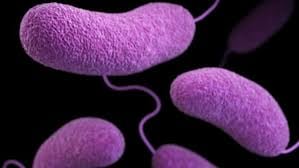
 Vibrio is a genus of Gram-negative bacteria, which have a characteristic curved-rod (comma) shape
There are several species of which can cause foodborne infection or soft-tissue infection called Vibriosis.
Infection is commonly associated with eating undercooked seafood.
Being highly salt tolerant and unable to survive in freshwater, Vibrio spp. are commonly found in various salt water environments.
Vibrio spp. are facultative anaerobes that test positive for oxidase and do not form spores.
All members of the genus are motile, and have polar or lateral flagellum with or without sheaths.
Vibrio species typically possess two chromosomes, which is unusual for bacteria.
Each chromosome has a distinct and independent origin of replication, and are conserved together over time in the genus.
The genus Vibrio contains a large number of species, and these vary somewhat in their biochemical characteristics.
Most disease-causing strains are associated with gastroenteritis, but can also infect open wounds and cause sepsis.
They can be carried by numerous marine animals, such as crabs or prawns, and have been known to cause fatal infections in humans after exposure.
Risk of clinical disease and death increases with certain factors, such as uncontrolled diabetes, elevated iron levels as with cirrhosis, sickle cell disease, hemochromatosis, and cancer or other immunocompromised states.
Pathogenic Vibrio species include V. cholerae the causative agent of cholera, V. parahaemolyticus, and V. vulnificus.
V. cholerae is generally transmitted by contaminated water.
Pathogenic Vibrio species can cause foodborne infection, usually associated with eating undercooked seafood.
When ingested Vibrio bacteria can primarily result in watery diarrhea along with other secondary symptoms.
V. vulnificus outbreaks commonly occur in warm climates and small, generally lethal, outbreaks occur regularly.
Foodborne Vibrio infections are most often associated with eating raw shellfish.
V. parahaemolyticus is also associated with the Kanagawa phenomenon, in which strains isolated from human hosts clinical isolates are hemolytic on blood agar plates, while those isolated from nonhuman sources are not hemolytic.
Many Vibrio species are also zoonotic, causing disease in fish and shellfish, and are common causes of mortality among domestic marine life.
A common sign of Vibrio infection is cholera.
Cholera primarily presents with rapid water loss by watery diarrhea.
Other symptoms include vomiting and muscle cramps.
Water loss can lead to dehydration.
V. cholerae is the most common pathogen that causes cholera.
The gold standard for detecting cholera is through cultures of stool samples or rectal swabs.
Identification through microscopy or by agglutination of antibodies, and cultures are done in thiosulfate citrate bile-salts sucrose agar.
Vibriosis is a sign of a more severe Vibrio infection.
Vibriosis or vibrio infection is an infection caused by bacteria of the genus Vibrio.
About a dozen species can cause vibriosis in humans, with the most common in multiple countries across the Northern Hemisphere being Vibrio parahaemolyticus, Vibrio vulnificus, and Vibrio alginolyticus.
Common causes of vibriosis include consumption of raw or undercooked seafood, primarily oysters, or wound exposure to sea water.
The majority of V. parahaemolyticus infections can be self-limiting and symptoms include diarrhea, nausea, headaches, fever and chills.
V. vulnificus can lead to a more serious disease, particularly in wound infection which can turn into necrotizing fasciitis.
V. parahaemolyticus is the most common pathogen in vibriosis, however V. vulnificus is more common in people who have certain risk factors like older age, liver disease or diabetes mellitus.
Like all vibrio diagnosis, vibriosis can also be determined in stool cultures.
V. parahaemolyticus and V. vulnificus will form green colonies.
Undercooked shellfish can also be a source of Vibrio infection, often leading to the milder form of gastrointestinal vibriosis.
Symptoms Diarrhea, abdominal cramps, nausea, vomiting, fever, wound infections.
Complications Dehydration, sepsis, necrotizing fasciitis
Usual onset 12 to 72 hours after exposure.
Duration Several days to weeks.
Causes Infection by Vibrio species (V. parahaemolyticus, V. vulnificus, V. alginolyticus).
Risk factors Consuming raw/undercooked seafood, exposure to contaminated seawater or brackish water.
Diagnosis: Stool test, wound culture, blood culture
Prevention Cooking seafood thoroughly, avoiding exposure of wounds to brackish water or seawater.
Treatment Oral rehydration therapy, intravenous fluids, antibiotics-Doxycycline, ceftazidime
Prognosis Generally good with treatment; higher risk of severe outcomes in immunocompromised individuals
Frequency Thousands of cases annually in the US
Deaths Variable, higher in severe cases involving septicemia
Vibrio cholerae, can also commonly cause vibriosis, though only those strains that do not produce cholera-specific toxins: non-O 1 or non-O.
Vibriosis is also an animal disease and can cause harm to wild and farmed fish, among others.
The genus Vibrio includes various species that can cause illness in humans, including Vibrio parahaemolyticus and Vibrio vulnificus.
These bacteria thrive in warm, brackish water and are often found in shellfish such as oysters, clams, and mussels.
Vibriosis can be contracted through:
Consumption of raw or undercooked seafood, particularly shellfish.
Exposure of open wounds or broken skin to warm seawater or brackish water containing Vibrio bacteria.
The symptoms of vibriosis can vary depending on the species involved:
Vibrio parahaemolyticus: Leads to gastrointestinal illness, with symptoms such as diarrhea, abdominal cramps, nausea, vomiting, and fever.
Vibrio vulnificus: Can cause severe wound infections and septicemia, especially in immunocompromised individuals.
Vibrio alginolyticus: Typically causes wound and ear infections.
Vibriosis incidence is influenced by environmental factors such as water temperature and salinity.
Warmer temperatures, including in relation to global warming, have been linked to increased prevalence of vibriosis as Vibrio bacteria thrive in warmer conditions.
It has an association with warm water activities, especially during unusually warm summers.
There is a seasonal nature to the infections, which typically occur during the warmer months when people are more likely to engage in water-related activities.
Diagnosis of vibriosis involves:
Clinical evaluation: Based on symptoms and exposure history.
Laboratory testing: Isolation and identification of Vibrio species from stool, wound, or blood samples.
Treatment of vibriosis depends on the severity and type of infection:
Medical care depends on the clinical presentation and the presence of underlying medical conditions.
Mild case often resolve without treatment, and oral rehydration therapy may be used.
Because Vibrio gastroenteritis is self-limited in most patients, no specific medical therapy is required.
Severe cases of vibriosis may require hospitalization, intravenous fluids, and antibiotics such as doxycycline or ceftazidime.
Preventative measures to reduce the risk of vibriosis include:
Cooking seafood thoroughly and avoiding raw shellfish.
Avoiding exposure of open wounds to seawater and using waterproof bandages if contact is unavoidable.
Although most Vibrio species are sensitive to antibiotics, such as doxycycline or ciprofloxacin, antibiotic therapy does not shorten the course of the illness or the duration of pathogen excretion.
However, if the patient is ill and has a high fever or an underlying medical condition, oral antibiotic therapy with doxycycline or ciprofloxacin can be initiated.
Patients with non-cholera Vibrio wound infection or sepsis are much more ill and frequently have other medical conditions.
Medical therapy for non-cholera Vibrio wound infection or sepsis requires prompt initiation of effective antibiotic therapy (doxycycline or a quinolone)
Intensive medical therapy with aggressive fluid replacement and vasopressors for hypotension and septic shock to correct acid-base and electrolytes abnormalities that may be associated with severe sepsis
Early fasciotomy within 24 hours after development of clinical symptoms can be life-saving in patients with necrotizing fasciitis.
Early debridement of the infected wound is indicated to avoid amputation of fingers, toes, or limbs.
Cholera prevention:
Improvement of water and food safety: includes the sanitation of water, proper preparation of food and community awareness of outbreaks.
Cholera vaccines.
Prevention of vibriosis is mostly effective in food processing.
Food items, mostly seafood, that commonly contain vibrio organisms are regularly managed.
The water that seafood is fished or farmed is analyzed to determine microorganism content.
Food processing methods like pasteurization and high pressure are used to eliminate microorganisms and pathogens.
In Vibrio spp, most have a single flagellum located on one pole of the bacterium, although some species have additional flagella in peritrichous or lophotrichous arrangements.
The gradient used to power the flagellar motor is sodium driven rather than proton driven; this creates greater torque, and Vibrio flagella have been shown to rotate over five times faster than the H+-driven flagella of E. coli.
The flagellum is also surrounded by a sheath extending from the membrane.
Motility is very important for Vibrio spp for infection.
Loss of motility in Vibrio has shown impaired colonization and adherence to host’s intestines.
Natural transformation is a common bacterial adaptation for DNA transfer that employs numerous bacterial gene products.