
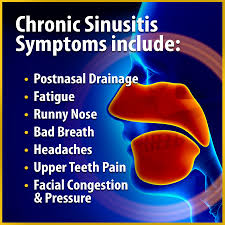
 Chronic rhinosinusitis defined by symptoms present for at least three months and can occur with or without acute exacerbation, and with or without nasal polyposis.
Defined by symptomatic inflammation of the paranasal sinuses with common symptoms including nasal obstruction, facial pressure or fullness, nasal discharge, and olfactory loss in conjunction with endoscopic or imaging findings of sinonasal inflammation.
Associated with reductions in quality-of-life, sleep quality, and daily productivity.
Estimated prevalence is 12% in Western countries.
A common underecognized chronic inflammatory disease affecting proximally 3-7% of the population.
Chronic rhinosinusitis is the most common chronic respiratory disorder.
Can be divided into chronic sinusitis with or without nasal polyposis.
Healthcare costs estimated $9 billion per year with societal cost exceeding $13 billion per year.
Patient reported quality of life measures for patients with chronic sinusitis is lower than that for congestive heart failure, COPD, or Parkinson’s disease.
Previously thought to be entirely infectious in its etiology.
Now recognized as an inflammatory process of the upper airways analogous to asthma in the lower airways.
The etiology is multi factorial including bacterial agents, epithelial cell defects, bacterial biofilms, T-helper 1 and 2 inflammation , tissue remodeling, genetic variations in HLA haplotypes and bitter-taste receptors.
Bitter-taste receptors have genetic variation and can be associated with refractory chronic sinusitis.
Normally sinonasal-ciliated epithelium cells express bitter-taste receptors stimulated by bacterial products and activate immune host responses to remove and kill bacteria by releasing nitric oxide.
Presently chronic sinusitis is classified based on the presence or absence of nasal polyps.
Chronic rhinosinusitis without nasal polyps may be idiopathic or ontogenic or caused by immuno deficiency, vasculitis or autoimmune processes.
Smoking is not a strong risk factor for chronic rhinosinusitis with nasal polyps.
The majority of chronic rhinosinusitis sinusitis with nasal polyps are idiopathic or may be related to genetic, metabolic, or immunologic diseases.
Chronic rhinosinusitis with nasal polyps, has an estimated prevalence of one to 4% worldwide and typically manifest as nasal congestion, loss of smell, nasal discharge, and rhinorrhea, reducing quality of life and productivity.
The majority of Caucasians with chronic rhinosinusitis with nasal polyps have a type two pattern of inflammation, with eosinophilia, and elevated levels of interleukin-4, interleukin-5, and interleukin 13 cytokines.
Endotype patterns of immune response have been identified by three distinct mechanisms in chronic sinusitis.
T1 for acellular bacteria and viruses, T2 for helminths, and T3 for extracellular bacteria and fungi.
T1 inflammation involves macrophages, interferon gamma, and tumor necrosis factor A; T2 has eosiniphils, IL4, IL 5, IL9 and IL13;and T3 has neutrophils, IL 17 and IL 22.
Aberrant immune responses occur in T1 and T3 inflammatory pathways in autoimmune diseases, and overactive. T2 inflammation is noted in atopic diseases.
Chronic rhinosonusitis may involve many sub types and phenotypes with inflammatory patterns, including T1, T2, and T3.
There is distinct immune activation for each type of endotype involving unique set of activated cells and inflammatory mediators.
The goals of medical treatment is to reduce mucosal inflammation, remove mucus, and modulate environmental triggers.
Most common bacterial organisms are Staphylocci epidermidis, Staphylococci aureus, Streptococcus pneumoniae and anaerobes.
Medical therapy begins with daily application of topical intranasal corticosteroids in conjunction with high-volume saline irrigation.
Medical management with chronic sinusitus and nasal polyposis focuses on controlling inflammation and includes intranasal corticosteroids, nasal saline irrigation, use of antibiotics, or oral steroids.
If symptoms and polyps persist, despite medical management, surgical excision is a consideration.
Reoccurrence of sinusitus symptoms and polyposis after surgery approaches 50% in patients with tissue eosinophilia.
Associated with his 3.5 fold increase in prevalence of asthma.
Topical corticosteroid therapy for chronic sinusitis with and without nasal polyps is highly recommended for chronic sinusitis.
High volume corticosteroid irrigations may be more effective than low-volume corticosteroid spray techniques but clinical trials are required.
Saline irrigations assist in the removal of mucus and possible environmental triggers and assist in restoring normal mucociliary clearance.
While saline irrigations improve symptoms scores, it alone is associated with less improvement than when utilized with topical corticosteroid therapy.
Intranasal corticosteroids are the first line treatment for chronic rhinitis with nasal polyps, followed by systemic corticosteroids and/or endoscopic sinus surgery if nasal steroids are ineffective.
Biologics such as dupilimab, mepolizumab and omalizumab have emerged as additional treatments for chronic rhinosinusitis with nasal polyps with analysis indicating that monoclonal antibodies targeting IL- 4R alpha demonstrate superior efficacy in reducing polyps size and nasal congestion compared with other biologics.
Stapokibart is a high-efficient, humanized antibody targeting the interleukin-4 receptor alpha subunit (IL-4Rα) approved for chronic rhinosinusitis: with marked reduction in nasal polyp score: targets T2 inflammation.