
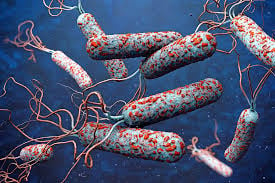
 Epidemic diarrheal disease caused by bacterium Vibrio cholerae.
Cholera is an infection of the small intestine by some strains of the bacterium Vibrio cholerae.
Cholera is spread mostly by unsafe water and unsafe food that has been contaminated with human feces containing the bacteria.
Involves 3–5 million people a year, and causes 28,800–130,000 deaths a year.
Cholera is currently endemic and nearly 50 countries.
Death 28,800 in 2015.
Cholera is currently endemic in nearly 50 countries causing millions of cases in tens of thousands of deaths each year.
Cholera primarily affects the world’s poorest people, especially those who lack access to safe water and adequate sanitation ad hygiene facilities.
Displaced populations and refugees are a particular risk and severe weather events and disasters can precipitate outbreaks and epidemics.
WHO estimates the least 2 billion people lack access to safely managed drinking water, more than 3 billion do not have safety managed sanitation, and more than 350 million defecate in the open each day.
Caused by a number of types of Vibrio cholerae.
Some types of Vibrio produce more severe disease than others.
Humans alone are affected.
Undercooked seafood is a common source.
Most cholera cases in developed countries are a result of transmission by food, while in the developing world it is more often water.
Risk factors include: Poor sanitation, not enough clean drinking water, poverty.
01 0r 0139 types important cause of severe dehydrating diarrhea in Asia and Africa.
V. Cholerae’s natural environment is an aquatic environment.
Symptoms may range from none, to mild, to severe.
Cholera primarily presents with rapid water loss by watery diarrhea.
Other symptoms include vomiting and muscle cramps.
Water loss can lead to dehydration.
V. cholerae is the most common pathogen that causes cholera.
The gold standard for detecting cholera is through cultures of stool samples or rectal swabs.
Identification through microscopy or by agglutination of antibodies, and cultures are done in thiosulfate citrate bile-salts sucrose agar.
Symptoms start two hours to five days after exposure.
The process is associated with large amounts of watery diarrhea that lasts a few days.
Secondarily, vomiting and muscle cramps may also occur.
It can lead to severe dehydration and electrolyte imbalance, within hours.
Can cause acute, severe, watery diarrhea, dehydration and death.
Untreated, severe cholera results in high mortality, approaching 40%, from dehydration and shock.
In 2009 a total of 221,226 cases of cholera were reported and 4946 deaths from cholera were reported to the WHO, however the actual number of annual cases is thought to be substantially higher.
Bacteria can multiply rapidly under proper conditions and create a waterborne spread of the disease.
Driving forces in cholera outbreaks are primarily contaminated drinking water and inadequate sanitation.
Outbreaks are frequent in Asia and Africa.
Diagnostic method Stool testing.
Prevented by improved sanitation, clean water, cholera vaccines.
78-84% of patients given oral rBS-wc cholera vaccine develop protection in the setting of sub-Saharan Africa.
The oral cholera vaccine is 50–60% effective over 2 years.
Oral cholera vaccine can be 50 to 85% effective in protecting the community for one to five years.
It is not particularly effective in children under five years of age.
WHO estimates that at least 1/3 of global cholera cases and deaths occur in children, five years of age or younger, and young children are significantly more likely than older people to have clinical disease on exposure.
Protection of cholera is largely targets polysaccharide O-antigens of V. Cholerae 01.77j8
Antibiotic treatment substantially reduces the duration and volume of diarrhea and shortens hospitalizations and decreased adjunctive fluid requirements.
Treatment:
Oral rehydration therapy, zinc supplementation, intravenous fluids, antibiotics.
Oral rehydration solution is the mainstay of treatment and should begin as soon as symptoms develop, and maintained until hydration returns to normal.
Oral rehydration solution, combined with intravenous rehydration for those with severe dehydration, has reduced case fatality rates to less than 1% .
Tetracycline and its derivatives have been the major treatments for 40 years, and are effective when used a single dose.
Tetracycline use relatively contraindicated when treating infections in children or pregnant women.
Resistance to tetracyclines has been reported.
Cholera vaccination is no longer required by any country as the risk to typical travelers is insignificant.
Cholera vaccination is considered in endemic or epidemic areas.
One reply on “Cholera”
Dear standardofcare.com webmaster, Your posts are always well-delivered and engaging.