 Arteries are muscular, elastic blood vessels that primarily carry oxygen-rich blood away from the heart to the rest of the body’s tissues and organs.
Unlike veins, which bring blood back to the heart, arteries transport blood away from the heart (with the sole exception of the pulmonary arteries, which carry deoxygenated blood to the lungs).
An artery is defined by the direction blood travels—not its oxygen content.
Because they receive blood directly pumped from the heart’s left ventricle, arterial walls are thick, muscular, and elastic to handle high pressure and create a measurable pulse.
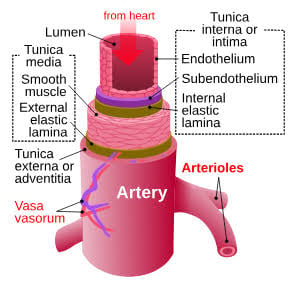
Three Layers: An artery’s wall consists of the inner tunica intima, the middle tunica media (smooth muscle and elastic tissue), and the outer tunica externa/adventitia.
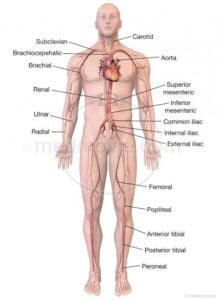
The largest artery is the aorta, which branches into smaller arteries, down to threadlike arterioles, and finally into microscopic capillaries where nutrient and gas exchange occurs. Major Arteries in the Body
Aorta: The main systemic artery originating from the left ventricle, splitting into the ascending aorta, aortic arch, thoracic aorta, and abdominal aorta.
Pulmonary Arteries: Transport oxygen-depleted blood from the heart’s right side to the lungs.
Coronary Arteries: Branch off the base of the aorta to supply oxygen-rich blood directly to the heart muscle.
Carotid Arteries: Supply blood up the neck to the brain.
Iliac and Femoral Arteries: Major branching arteries that extend blood flow down into the pelvis and legs.
Common Conditions
Atherosclerosis: The buildup of fats, cholesterol, and other substances (plaque) inside arterial walls, leading to narrowing and restricted blood flow.
Aneurysm: A dangerous bulge or ballooning in a weakened arterial wall that risks rupturing.
Coronary Artery Disease (CAD) & Peripheral Artery Disease (PAD): Plaque accumulation affecting heart-supplying or limb-supplying arteries, which can lead to chest pain, claudication, heart attacks, or strokes.
The heart pumps blood into large arteries, which branch into smaller arteries and then tiny vessels called arterioles.
Arterioles widen or narrow to control how much blood reaches tissues and help regulate blood pressure.
Blood then enters capillaries, where exchange with tissues takes place, before returning toward the heart through veins.
Arteries have strong, elastic walls that withstand the pressure of the heartbeat.
Their walls have three layers:
– Inner layer (tunica intima): a smooth lining in contact with the blood. – Middle layer (tunica media): smooth muscle and elastic tissue that allow the artery to stretch and change diameter. – Outer layer (tunica externa): connective tissue that supports and anchors the vessel.
A common problem is atherosclerosis—the buildup of fatty plaque in artery walls—which can narrow arteries and limit blood flow.
When it affects the coronary arteries, it can deprive heart muscle of oxygen and lead to a heart attack.
Similar arterial disease can affect blood supply to the brain or limbs.