
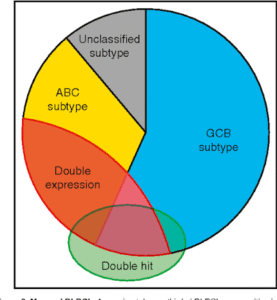
 ABC (Activated B-cell-like) and GCB (Germinal Center B-cell-like) are the two primary molecular subtypes of Diffuse Large B-Cell Lymphoma (DLBCL).
They originate from different stages of normal B-cell development in the lymph nodes, feature distinct genetic mutations, and carry different prognostic and treatment considerations.
ABC (activated B-cell–like) and GCB (germinal center B-cell–like) are gene-expression–defined cell-of-origin (COO) subtypes of DLBCL-NOS that arise from B cells arrested at different stages of germinal center transit, use distinct oncogenic pathways, and carry different prognoses.
Arises from post-germinal center B cells that are arrested on their way to becoming plasma cells.
Frequently characterized by chronic activation of the NF-κB pathway (driven by mutations in genes like MYD88 and CD79A/B).
Often reported in pathology labs as “non-GCB” (though non-GCB is slightly broader than pure ABC).
ABC: transcriptional signature resembling a plasmablast or BCR-activated B cell; driven by chronic active BCR signaling and constitutive NF-κB activation, with high IRF4/MUM1 and a blocked plasma-cell differentiation program (Blimp-1 lesions).
Most have not class-switched and express IgM.
Enriched genetic lesions: MYD88 L265P, CD79B, CARD11, NOTCH1; LymphGen MCD and N1 subtypes (poor risk).
GCB Subtype Cell of Origin)Arises from B cells in the germinal center dark zone, where somatic hypermutation occurs.
Arises from B cells in the germinal center light zone or those immediately exiting the germinal center.
Often features genetic alterations such as EZH2 mutations or BCL6 translocations.
More common; accounts for roughly 60-65% of all DLBCL cases.
Key Genetic Drivers- Frequent BCL2 translocations (e.g., t(14;18))- EZH2 mutations- PTEN loss- Constitutive activation of the NF-κ B signaling pathway, MYD88 mutations, CD79B mutationsImmunohistochemistry (IHC)
Often expresses CD10 and BCL6.
Often expresses MUM1.
Prognosis & SurvivalMore favorable; historical 3-year progression-free survival is around 75%.
Worse overall survival; historical 3-year progression-free survival is closer to 40-50%.
Clinical Significance While standard front-line treatment for both subtypes is R-CHOP (Rituximab, Cyclophosphamide, Doxorubicin, Vincristine, and Prednisone), identifying whether a tumor is ABC or GCB is highly relevant due to these distinct biological pathways.
ABC Subtype Vulnerabilities: Because ABC DLBCLs rely heavily on the continuous activation of the NF-κ B and Bruton’s tyrosine kinase (BTK) pathways, they are a primary focus for targeted therapies, such as Bruton’s tyrosine kinase inhibitors (e.g., ibrutinib).
GCB Subtype Vulnerabilities: GCB DLBCLs may be targeted by PI3K inhibitors, EZH2 inhibitors, or specific BCL2 antagonists.
Diagnosis and differentiation of these subtypes are typically performed using Gene Expression Profiling (GEP) or immunohistochemical algorithms, such as the Hans algorithm, which utilizes CD10, BCL6, and MUM1 to classify cases.
ABC has inferior outcomes with R-CHOP (3-year PFS ~40–50% vs ~75% for GCB).
About 10–15% of cases remain unclassifiable
Immunophenotyping to establish GCB versus non-GCB origin an essential part of the diagnostic workup, though COO does not currently change first-line regimen selection outside a trial.
GCB: expresses germinal center genes including BCL6 and EZH2; ongoing somatic hypermutation and class switching.
Enriched for BCL2 translocation, EZH2, CREBBP, PI3K alterations (EZB/C3 subtypes).
Double-hit (MYC + BCL2 rearranged) HGBL is predominantly GCB, whereas MYC/BCL2 dual-expresser (non-translocated) disease is usually ABC/non-GC.
Gene expression profiling is the reference standard but IHC surrogates remain most widely used.
Multiple R-CHOP cohorts show inferior ABC outcomes: 5-year PFS/OS 31%/45% (ABC) vs 76%/80% (GCB) in one series; 48%/56% vs 73%/78% by Lymph2Cx in another.
ABC/non-GC COO is also associated with increased risk of CNS relapse.
Therapeutic implications
COO does not currently alter NCCN-recommended first-line therapy — R-CHOP and Pola-R-CHP (IPI ≥2) remain the preferred options regardless of subtype.
FrontMIND (tafasitamab + lenalidomide + R-CHOP in high-risk DLBCL): PFS HR 0.59 in ABC-like vs 0.69 in GCB-like; subgroups were not powered for significance.
REMoDL-B (5-year follow-up): no overall bortezomib benefit, but in ABC lymphoma 5-year OS 80% with RB-CHOP vs 67% with R-CHOP.
ROBUST (lenalidomide + R-CHOP restricted to GEP-confirmed ABC): primary PFS endpoint not met.
E1412 used higher-dose lenalidomide and showed a 34% reduction in progression/death overall (3-year PFS 73% vs 61%), with ABC.
Prognosis & Survival Rates
GCB Subtype: Generally associated with a more favorable prognosis and higher average 5-year survival rates (historically around 75% with standard chemoimmunotherapy).
Less common; accounts for roughly 30-35% of all DLBCL cases.
ABC Subtype:
Associated with an inferior prognosis and lower average survival rates (historically around 40% with traditional R-CHOP), though overall outcomes have improved with modern therapies.
Diagnosis & Testing
Gene expression profiling (GEP) provides the most accurate classification, but it is complex and not always standard in every routine clinical lab.
Immunohistochemistry (IHC): Most pathologists use the Hans algorithm (staining for proteins like CD10, BCL6, and MUM1) to divide DLBCL into GCB vs. non-GCB as a practical clinical proxy.
4. Treatment Implications
• Initial Therapy: Both subtypes are typically treated first-line with standard chemoimmunotherapy regimens such as R-CHOP or newer frontline variations (e.g., Pola-R-CHP).
Targeted Approaches: Because of their distinct biology, researchers are exploring subtype-specific strategies—such as targeting NF-κB/BTK pathways in ABC-type or EZH2 inhibitors in GCB-type.
A patient’s overall outlook depends heavily on additional factors like International Prognostic Index (IPI) score, stage, and co-occurring genetic hits (such as MYC/BCL2 “double-hit” status).