
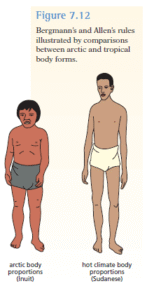
Bergmann’s Rule is a biological principle:within a widely distributed group of endothermic animals (mammals and birds), species in colder environments tend to be larger, while those in warmer regions are smaller.
Bergmann’s rule is a principle in evolutionary biology and biogeography stating that within a species, or among closely related species, individuals tend to be larger in colder climates and smaller in warmer ones.
Larger bodies have a lower surface-area-to-volume ratio, meaning they lose heat more slowly relative to the heat they generate.
This is advantageous in cold environments.
Smaller bodies have a higher surface-area-to-volume ratio, dissipating heat more efficiently — beneficial in hot climates.
So natural selection favors larger size where retaining heat matters, and smaller size where shedding heat matters.
The Mechanism: Large bodies have a smaller surface-area-to-volume ratio, which reduces heat loss in cold climates, while smaller bodies allow for better heat dissipation in warm environments.
A related principle: Allen’s Rule complements this by stating that animals in colder climates have shorter extremities (limbs, ears) to minimize heat loss.
The rule does not apply to all species, such as small burrowing animals that escape cold, and some studies on dinosaurs found no clear size-latitude relationship.
While some argue humans follow this trend, cultural and environmental factors are often more significant.
Climate Change: Observations suggest a reverse Bergmann’s rule, where animals are decreasing in size as global temperatures rise.
Body size correlates with latitude and temperature: animals in higher latitudes/closer to the poles are generally bigger than their counterparts in lower latitudes (closer to the equator
Humans: Population studies show a general trend of greater body mass at higher latitudes.
Deer: White-tailed deer in Canada are noticeably larger than those in the American South.
Penguins: Emperor penguins (Antarctic) are much larger than the little penguin (temperate Australia).
Allen’s rule is a related concept: appendages (ears, limbs, tails) tend to be shorter in colder climates, further reducing heat loss.
It remains one of the most widely cited ecogeographical rules, and is increasingly studied in the context of climate change — as temperatures rise, some species appear to be getting smaller, consistent with the rule’s predictions.