
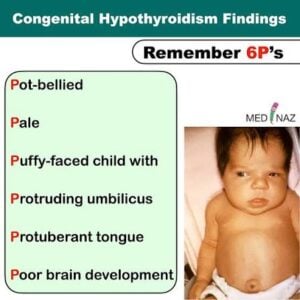
 Congenital hypothyroidism is a condition present at birth where a baby’s thyroid gland does not make enough thyroid hormone for normal body and brain growth.
Reported incidence is approximately 1 per 2,000–4,000 live births, varying by population and screening strategy.
Thyroid hormone is essential for normal brain maturation, linear growth, and metabolism—especially during the first 2–3 years of life.
Newborns can initially appear well because maternal \(T4) crosses the placenta, so clinical recognition alone is unreliable; this is why universal newborn screening is central to care.
A normal physical examination does **not** rule out CH.
It is a neonatal endocrine emergency in the sense that prompt detection and levothyroxine replacement can prevent otherwise permanent neurodevelopmental impairment.
Most babies look healthy at birth, but signs can appear later or develop slowly: Prolonged jaundice (yellow skin or eyes) Constipation Poor feeding or low appetite Sluggishness or excessive sleeping A hoarse cry Weak muscles or poor muscle tone (“floppy” baby) Large tongue and puffy face Umbilical hernia
Causes
Thyroid dysgenesis: The thyroid gland fails to form properly or is missing is the most common cause.
Thyroid dyshormonogenesis: The gland is present, but a chemical defect stops it from making hormones.
Primary permanent CH: dyshormonogenesis-Inherited defect in thyroid-hormone synthesis, such as iodine transport/organification or thyroglobulin-related disorders | Low free(T4) high TSH; gland often present and may be enlarged/goitrous
Primary CH results chiefly from dysgenesis or impaired hormone biosynthesis.
Primary permanent CH: thyroid dysgenesis -Agenesis, hypoplasia, or ectopic thyroid; the most common cause in iodine-sufficient regions.
Central CH | Hypothalamic or pituitary failure to generate an adequate TSH signal-Low free \(T4) with low, normal, or only mildly elevated TSH; may coexist with other pituitary deficits
Central CH is less common and can be missed by screening programs that rely on TSH alone.
Diagnosis: Found through routine newborn heel-prick blood tests checking T4 and TSH hormone levels.
Low free \(T4), high TSH; absent, small, or ectopic gland on imaging .
Newborn screening is performed from a heel-prick dried blood spot, commonly using either primary TSH testing or a \(T4\)-first strategy with reflex TSH.
A high TSH pattern identifies most primary CH; a low \(T4\) with non-elevated TSH should raise concern for central CH, delayed TSH elevation in preterm/ill infants, or non-thyroidal illness.
After an abnormal screen, obtain confirmatory serum:
TSH Free \(T4) preferably interpreted using age-specific neonatal ranges Often total(T4) depending on local protocol
Etiologic tests—thyroid ultrasound, radionuclide scintigraphy, serum thyroglobulin, urinary iodine assessment, maternal antibody history, and genetic testing—can be useful, but they should not delay treatment.
Treatment: Daily oral thyroxine (thyroid hormone replacement) crushed and mixed in milk or water for infants.
Outlook: Early treatment leads to normal physical and mental growth.
Transient CH-Maternal TSH-receptor blocking antibodies, maternal antithyroid drugs, iodine deficiency or excess, prematurity, or other neonatal factors.
Variable; may resolve, but treat initially if biochemical hypothyroidism is significant.
Many infants have no obvious signs at birth. When present, findings evolve over days to weeks and may include:
Treatment and follow-up
Start oral levothyroxine promptly once CH is confirmed or strongly suspected.
The American Academy of Pediatrics recommends an initial dose of 10–15 mcg/kg/day, given once daily; rapid initiation, ideally by 2 weeks of age when found on the first newborn screen, is associated with the best neurodevelopmental protection.
Treatment goals in early childhood are:
Bring free \(T4) promptly into the upper half of the age-appropriate reference range.
Normalize TSH without overtreatment.
Use frequent biochemical monitoring, particularly during infancy and after dose changes.
Maintain reliable daily administration; iron, calcium, soy, and certain formula/feed interactions can reduce levothyroxine absorption.
Most children with thyroid dysgenesis require lifelong replacement.
In children whose initial presentation suggests possible transient CH—such as a gland in situ with a low dose requirement—a supervised trial off therapy may be considered around age 3 years, when thyroid-dependent brain development is less vulnerable, under pediatric endocrinology guidance.
An abnormal newborn thyroid screen warrants urgent confirmatory testing and early levothyroxine—not watchful waiting.
With treatment started promptly and monitored carefully, most affected children can have normal growth and neurodevelopment; delay exposes the infant to preventable, potentially irreversible developmental injury.