
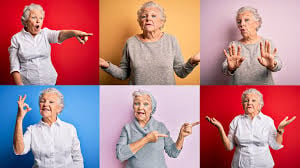
 Hands are one of the most expressive tools in human communication, working alongside speech, facial expressions, and posture.
Gestures by Type
Emblems are gestures with direct verbal equivalents — a thumbs up, the OK sign, or a wave goodbye.
These vary by culture s the OK sign means something offensive in some countries.
Illustrators accompany speech to reinforce or clarify meaning — tracing a shape in the air while describing an object, or moving your hand upward indicating the price went up.
These accompany and “draw” speech-pointing, shaping, or mimicking actions.: They increase with excitement or involvement.
Regulators manage conversational flow — a raised palm to signal “stop,” or an open hand extended toward someone to invite them to speak.
Adaptors are self-touching behaviors (fidgeting, wringing hands) that often reveal emotional states like anxiety or discomfort, usually unconsciously.
Hands Communicate Emphasis — striking the table or pointing sharpens the importance of what’s being said
Spatial relationships — showing size, distance, or direction when words alone are inefficient
Emotion — open palms tend to signal honesty and openness; clenched hands or hidden hands can signal tension or defensiveness
Authority — expansive hand gestures generally convey confidence and dominance; constrained movements can signal submission or uncertainty
Hand gestures are among the most culturally variable forms of nonverbal communication:The same gesture can be friendly in one country and deeply offensive in another.
The “come here” beckoning gesture, the number of fingers used to count, even the direction of a pointing finger all differ across cultures.
Those who use more deliberate, varied hand gestures are consistently rated as more credible, engaging, and persuasive.
Studies have found that viral speakers use roughly twice as many hand gestures as less-watched ones.
Hands become the primary linguistic system in sign languages— complete languages with grammar, syntax, and expressive range fully equivalent to spoken language, delivered entirely through hand shape, movement, and position.
Hands play a central role in human communication, both as part of nonverbal cues that accompany speech and as a primary mode of expression in sign languages.
They enhance, clarify, emphasize, and sometimes replace spoken words.
People gesture spontaneously when talking across all cultures.
These co-speech gestures are tightly synchronized with speech.
Hand gestures serve multiple purposes: Aid speech production: Gestures help speakers organize thoughts, access words, and reduce hesitation.
More gesturing occurs during spontaneous or difficult speech.
Hand gestures add information beyond words—roughly increasing message value by up to 60% in some studies.
They make communication more engaging, memorable, and persuasive.
Listeners retain more when speakers gesture.
Reveal cognition and emotion: Hand movements often show unspoken thoughts, attitudes, or emphasis.
Open palms can signal honesty; clenched fists may show anger or determination.
Gestures are especially useful for describing spatial relationships, actions, or sizes.
Emblems: Culturally specific symbols with direct translations-e.g., thumbs-up for approval, OK sign, or V-sign).
These can stand alone.
Adaptors (or manipulators): Self-touching (e.g., rubbing hands, fidgeting) often linked to stress or comfort.
Regulators: Help manage conversation flow (e.g., raising a hand to pause or signal turn-taking).
Affect displays: Convey emotions (e.g., hands over face for shock).
Benefits:
Public speaking/presentations: Purposeful gestures boost attention, credibility, and retention.
Symmetrical open-palm gestures convey openness; matching gestures to content adds impact.
Visible hands signal trustworthiness and competence.
Hiding hands can seem evasive.
Gesturing helps speakers and listeners process information better.
Overuse or mismatched gestures (gesture-speech mismatch) can confuse listeners.
Hand gestures are highly cultural— the same movement can have opposite or offensive meanings:
Thumbs-up: Positive in the US/Europe; rude or offensive in parts of the Middle East, Greece, or Iran.
OK sign (thumb + index finger circle): “All good” in the US; obscene in Brazil, Germany, or Russia; “money” in Japan.
Palm up (beckoning): Polite in the West; rude in parts of Asia.
V-sign: Peace/victory (palm out) in many places; insult (palm in) in the UK/Australia/South Africa.
In Deaf communities, hands (along with facial expressions, body posture, and space) form complete languages like American Sign Language (ASL).
These are not gesture systems but full linguistic systems with grammar, syntax, and vocabulary.
Fingerspelling supplements signs.
Hands are powerful tools that make communication richer, more precise, and more human.
Most people gesture naturally—becoming aware of them allows you to use them more intentionally for better connections.