
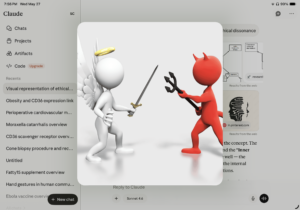
 Ethical dissonance is a specific form of cognitive dissonance that occurs when your actions clash with your moral values.
Ethical dissonance is the psychological discomfort you feel when your actions , or inactions) conflict with your own moral standards or self-image as an ethical person.
It’s an internal struggle you feel when you believe in being an honest, ethical person but find yourself doing something that contradicts that image.
Ethical dissonance is a subtype of cognitive dissonance where at least one of the conflicting cognitions is explicitly moral:
Ethical dissonance can occur prospectively as anticipating a moral violation or retrospectively, after a violation has occurred).
Most people have a strong need to see oneself as “good”.
When one’s behavior that violates this self-image—like misleading a customer or lying to a friend—our brain experiences a sharp psychological discomfort.
This psychological discomfort is essentially a “moral gatekeeper” warning us that we’ve crossed a line.
To stop the psychological discomfort people often use psychological defense mechanisms:
Rationalization: Making excuses, like “everyone does it” or “it’s just one time,” to make the behavior feel acceptable.
Double-Distancing: A phenomenon where a person who has behaved unethically judges others more harshly to prove their own virtue: the pot calling the kettle black.
Moral Cleansing: Trying to wash away guilt by doing a good deed in a different area—for example, donating to charity after a dishonest act at work.
Moral Disengagement: Convincing yourself that the usual ethical rules don’t apply to this specific situation.
Resolving ethical dissonance:
Using it as a cue for alignment by
Acknowledging the gap between your values and actions without harsh self-judgment.
Redesigning your habits to make the ethical choice.
Taking curative action to atone for the behavior and restore your sense of integrity.
Mechanisms and defenses
Clays people reduce ethical dissonance include:
Justification and rationalization Minimizing harm
These strategies preserve a moral self-image while allowing continued participation in behavior the person would otherwise condemn.
Ethical dissonance is described in: Sustainability and consumer behavior: knowing one’s environmental values while making convenience-driven, unsustainable choices.
Organizational and leadership settings: when personal ethics conflict with organizational pressures or destructive leadership.
Morally injurious contexts when what one did in a role conflicts with what one believes on ought to have done.
Ethical dissonance-a clash between ‘is’ and “ought” can lead to distress, moral fatigue, or, if unresolved, moral injury. Ethical dissonance
Over time, unresolved ethical dissonance can manifest as guilt, shame, cynicism, burnout, or withdrawal from advocacy and systemic change.
Recognizing ethical dissonance: Anticipate dissonance and avoid moral violations.
Reflect on their rationalizations and move toward aligning behavior with values or, when appropriate, revising overly rigid moral standards.