
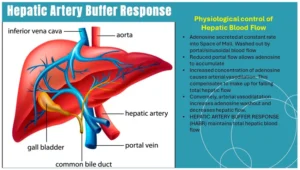
 The Hepatic Arterial Buffer Response (HABR) is an intrinsic regulatory mechanism of the liver that automatically increases hepatic arterial blood flow when portal venous flow decreases.
It is the liver’s method for maintaining a constant total blood supply, ensuring the organ continues to receive adequate perfusion for metabolic and clearance functions.
Changes in portal flow affect arterial flow, changes in arterial flow do not affect portal flow.
The buffering response can typically compensate for roughly 25% to 60% of the lost portal venous flow.
This response is not driven by the liver’s local oxygen or metabolic needs, but rather by hemodynamic homeostasis.
The most widely accepted theory for how HABR works is the adenosine washout hypothesis:
Adenosine Accumulation: Adenosine, is a potent vasodilator, and is produced at a constant rate in the area surrounding hepatic arterioles and portal venules.
Under normal conditions, portal blood flow “washes away” this adenosine into the systemic circulation.
When portal flow decreases, less adenosine is washed away resulting in higher local concentration of adenosine causing the hepatic artery to dilate, increasing arterial blood flow to the liver.
Clinical Significance
Liver Transplantation: HABR is crucial during and after transplant.
Small-for-size syndrome, refers to excessive portal flow that can cause the hepatic artery to constrict significantly via the buffer response, potentially leading to arterial thrombosis or graft dysfunction.
Cirrhosis: In advanced cirrhosis/liver-problems-cause-high-blood-pressure, the HABR may be chronically activated or impaired, making the liver more vulnerable to drops in blood pressure or flow.
Portal Vein Thrombosis: A blocked portal vein blood-vessel-disorder trigger HABR, which can be seen on imaging as a markedly dilated hepatic artery.