
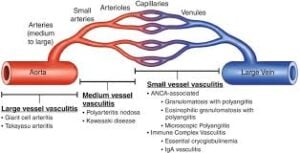
 Large vessel vasculitis (LVV) is a chronic inflammatory disease affecting the aorta and its major branches, comprising primarily giant cell arteritis (GCA) and Takayasu arteritis (TAK).
These conditions cause immune-mediated panarterial granulomatous inflammation that can lead to serious complications including vision loss, arterial stenosis, aneurysms, and dissections.
GCA predominantly affects individuals over 50 years of age and commonly involves the extracranial branches of the carotid artery, particularly the temporal artery, as well as the aorta and its major branches.
TAK typically occurs in younger patients, especially women, and primarily affects the aorta and its main branches.
The pathophysiology involves an unknown antigen that triggers immune cell infiltration through the vasa vasorum in the adventitia.
Dendritic cells activate T cells, which differentiate into Th1 and Th17 subsets, releasing cytokines-TNF, IFN-γ, IL-6, and IL-17, that stimulate macrophages to form granulomas and giant cells.
This transmural inflammation disrupts the elastic laminae and causes vessel wall thickening, neovascularization, and extracellular matrix remodeling.
Diagnosis relies heavily on noninvasive vascular imaging with ultrasound, CT/MR angiography, and PET/CT rather than biopsy alone, particularly for detecting large vessel involvement.
Treatment traditionally involves glucocorticoids, though tocilizumab is approved as a glucocorticoid-sparing agent for GCA and shows efficacy in TAK.