
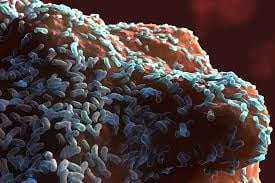
 Biofilms are complex, highly organized communities of microorganisms (bacteria, fungi, or algae, sometimes archaea and protozoa that attach to surfaces and become encased in a self-produced slimy matrix.
It is estimated that biofilms are involved in up to ~80% of human microbial infections, especially chronic and device‑associated infections.
A biofilm occurs when microorganisms attach to a surface and embedded in a self‑produced matrix of extracellular polymeric substances (EPS).
This matrix, known as the Extracellular Polymeric Substance (EPS), consists of polysaccharides, proteins, lipids, and DNA.
This EPS typically contains polysaccharides, proteins, lipids, and extracellular DNA, and creates a 3‑D scaffold that protects the cells and allows nutrient sharing and cell–cell signaling.
Cells in a biofilm differ phenotypically from their planktonic counterparts, with altered gene expression, metabolism, and growth rates that confer increased tolerance to antibiotics, disinfectants, and host immune responses.
Biofilms are found almost everywhere that is moist, from slippery rocks in streams (pond scum) to the plaque on human teeth.
Resistance: The protective matrix makes microbes in a biofilm up to 1,000 times more resistant to antibiotics, disinfectants, and immune responses than free-floating cells.
Microbes use chemical signals and communicate in a process called quorum sensing, which allows them to coordinate behaviors like growth and toxin production.
Mature biofilms often contain water channels that act as a rudimentary “circulatory system” to deliver nutrients and remove waste.
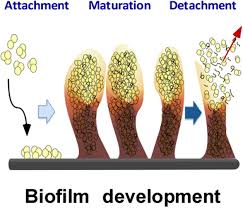
Free-floating cells land on a surface and stick, anchoring themselves permanently using pili and begin secreting the EPS matrix.
The colony grows into a complex three-dimensional structure.
Biofilm development is often described in sequential stages.
Initial reversible attachment of planktonic cells via weak forces (van der Waals, hydrophobic interactions).
Irreversible attachment mediated by adhesins, pili, and production of EPS.
Early maturation with microcolony formation and development of a 3‑D architecture containing water channels.
Late maturation, with spatial differentiation, metabolic stratification, and quorum‑sensing–regulated behavior.
Dispersion, in which cells or aggregates detach and seed new sites.
Some cells or clumps break off to travel through fluid and start new biofilms elsewhere.
Biofilms cause roughly 60% to 80% of all microbial infections, particularly those involving medical implants like catheters, pacemakers, and artificial joints.
They are also central to chronic conditions like cystic fibrosis and chronic wounds.
Industrial: They can clog water pipes, corrode metal surfaces, and decrease the efficiency of heat exchangers in power plants.
Beneficial Uses: Biofilms are used in bioremediation to clean up oil spills and in wastewater treatment facilities to digest organic pollutants.
Biofilms can form on biotic and abiotic surfaces in virtually any moist environment, from teeth and gut mucosa to catheters, industrial pipelines, and rocks in streams.
Biofilm communities may be single species in some settings, as in certain device infections, but are typically polymicrobial consortia in nature, with complex cooperative and competitive interactions.
Dental plaque, where oral bacteria attach to tooth enamel, form microcolonies in EPS, and ultimately create a mature biofilm that contributes to caries and periodontal disease.
It is estimated that biofilms are involved in up to ~80% of human microbial infections, especially chronic and device‑associated infections.
Common biofilm‑associated conditions include dental plaque and gingivitis, chronic otitis media, chronic rhinosinusitis, bacterial vaginosis, catheter‑associated UTIs, prosthetic joint and valve infections, and Pseudomonas infections in cystic fibrosis.
Biofilm‑embedded microbes may withstand antibiotic concentrations many times higher than planktonic MICs and evade phagocytosis and humoral factors, contributing to treatment failure and recurrence.
Environmental biofilms are ubiquitous in soils, aquatic systems, and on plant surfaces, where they drive nutrient cycling and can form the structural basis of microbial mats.
Biofilms are exploited in wastewater treatment and bioremediation because diverse metabolic capabilities within the consortium allow degradation of complex pollutants.
They cause biofouling and corrosion in pipelines, marine structures, and medical equipment, necessitating design and material strategies to limit attachment and EPS formation.