
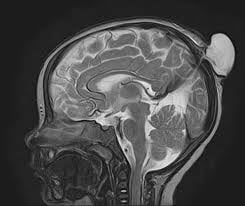
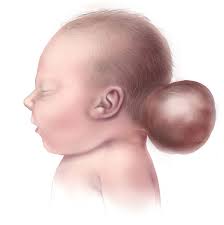
 A cephalocele is a rare congenital neural tube defect where intracranial contents herniate through a defect in the skull and dura mater.
It is estimated to occur in 0.8 to 5 per 10,000 live births.
The condition is categorized based on what protrudes through the skull opening:
Meningocele: Contains only the protective layers (meninges) and cerebrospinal fluid (CSF).
Encephalocele: Contains meninges, CSF, and brain tissue
Encephalocystocele: Contains meninges, CSF, brain tissue, and a portion of the ventricular system.
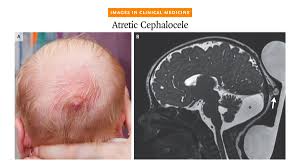
Atretic Cephalocele: A small, skin-covered subscalp nodule containing dura, fibrous tissue, and vestigial or degenerated brain tissue.
Cephalocele by Location:
Occipital: Located at the back of the head. This is the most common type in North America and Europe (70–90%).
Frontoethmoidal (Sincipital): Located at the forehead, nose, or eye area. These are more common in Southeast Asia.
Basal: Located at the base of the skull, often manifesting in the nasal cavity or throat.
Cranial Vault: Located at the top or sides of the head (parietal, temporal, or frontal).
Prenatal: Often detected via routine ultrasound as early as the first trimester.
Fetal MRI is frequently used to provides more detailed assessment.
The primary treatment is surgery, typically performed in infancy (birth to 4 months) unless the defect is not skin-covered, which requires urgent intervention to prevent infection.
It is frequently associated with hydrocephalus, microcephaly, and genetic syndromes like Meckel-Gruber syndrome (characterized by cephalocele, polycystic kidneys, and polydactyly).
Prognosis: The outlook depends heavily on the location and amount of herniated brain tissue.
Frontal cephaloceles generally have higher survival rates, at near 100%. and better neurodevelopmental outcomes.
Occipital cephaloceles have lower survival rates (approx. 55%) and a higher risk of long-term neurological deficits, such as seizures, vision problems, and developmental delays.
Atretic forms typically have a more favorable prognosis, though they may still be associated with occult brain malformations.