
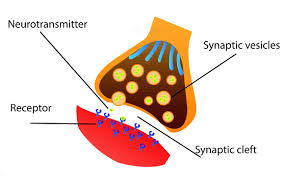
 A neurotransmitter is a signaling molecule secreted by a neuron to affect another cell across a synapse.
The cell that receives the signal, or target cell, may be another neuron, but could also be a gland or muscle cell.
Neurotransmitters are released from synaptic vesicles into the synaptic cleft where they are able to interact with neurotransmitter receptors on the target cell.
The neurotransmitter’s effect on the target cell is determined by the receptor it binds to.
Many neurotransmitters are synthesized from precursors such as amino acids.
Neurotransmitters are essential to the function of complex neural systems.
The exact number of unique neurotransmitters in humans is unknown.
More than 100 neurotransmitters have been identified.
Common neurotransmitters include glutamate, GABA, acetylcholine, glycine and norepinephrine.
Neurotransmitters are generally synthesized in neurons and are made up of, or derived from, precursor molecules that are found abundantly in the cell.
Classes of neurotransmitters include amino acids, monoamines, and peptides.
Monoamines are synthesized by altering a single amino acid: the precursor of serotonin is the amino acid tryptophan.
Peptide transmitters, or neuropeptides, are protein transmitters that often are released together with other transmitters.
Purine neurotransmitters, like ATP, are derived from nucleic acids.
Other neurotransmitters are made up of metabolic products like nitric oxide and carbon monoxide.
Amino Acids involve include glycine, glutamate.
Monoamines include serotonin, epinephrine, dopamine
Peptides-substance P, opioids
Purines ATP, GTP
Nitric oxide, carbon monoxide
Neurotransmitters are generally stored in synaptic vesicles, clustered close to the cell membrane at the axon terminal of the presynaptic neuron.
Some neurotransmitters, like the metabolic gases carbon monoxide and nitric oxide, are synthesized and released immediately following an action potential without ever being stored in vesicles.
Generally, a neurotransmitter is released at the presynaptic terminal as a response to an electrical signal called an action potential in the presynaptic neuron.
Baseline levels are released without electrical stimulation.
Neurotransmitters are released into and diffuse across the synaptic cleft, where they bind to specific receptors on the membrane of the postsynaptic neuron.
After being released into the synaptic cleft neurotransmitters diffuse across the synapse where they are able to interact with receptors on the target cell.
Depending on the receptor, binding of neurotransmitters may cause excitation, inhibition, or modulation of the postsynaptic neuron.
Acetylcholine is cleaved in the synaptic cleft into acetic acid and choline.to avoid continuous activation of receptors on the post-synaptic or target cell.
Neurotransmitters must be removed from the synaptic through one of three mechanisms: Diffusion – neurotransmitters drift out of the synaptic cleft, where they are absorbed by glial cells.
These glial cells, usually astrocytes, absorb the excess neurotransmitters.
Astrocytes, a type of glial cell in the brain, actively contribute to synaptic communication through astrocytic diffusion or gliotransmission.
Neuronal activity triggers an increase in astrocytic calcium levels, prompting the release of gliotransmitters, such as glutamate, ATP, and D-serine.
These gliotransmitters diffuse into the extracellular space, interacting with nearby neurons and influencing synaptic transmission.
Astra sites help maintain proper synaptic function by regulating extracellular neurotransmitter levels.
There is a bidirectional communication between astrocytes and neurons that manage brain signaling with implications for brain function.
Enzyme degradation occurs via proteins called enzymes that break the neurotransmitters down.
Reuptake– neurotransmitters are reabsorbed into the pre-synaptic neuron.
Transporters, or membrane transport proteins, pump neurotransmitters from the synaptic cleft back into axon terminals (the presynaptic neuron) where they are stored for reuse.
Acetylcholine is eliminated by having its acetyl group cleaved by the enzyme acetylcholinesterase; the remaining choline is then taken in and recycled by the pre-synaptic neuron to synthesize more acetylcholine.
Other neurotransmitters are able to diffuse away from their targeted synaptic junctions and are eliminated from the body via the kidneys, or destroyed in the liver.
All neurotransmitter have specific degradation pathways which may be targeted by the body’s regulatory system or medication.
Cocaine blocks a dopamine transporter responsible for the reuptake of dopamine.
Without such a transporter, dopamine diffuses much more slowly from the synaptic cleft and continues to activate the dopamine receptors on the target cell.
Histological examinations reveal a 20 to 40 nm gap between neurons, known as the synaptic cleft.
Neurotransmitter term applies to chemicals that carry messages between neurons via the postsynaptic membrane.
Neurotransmitters have little or no effect on membrane voltage, but a carrying function such as changing the structure of the synapse.
Neurotransmitters communicate by sending reverse-direction messages that affect the release or reuptake of transmitters.
The findings of neurotransmitters is typically determined using immunocytochemical techniques, which identify the location of either the transmitter substances themselves or of the enzymes that are involved in their synthesis.
Many transmitters, particularly the neuropeptides, are co-localized, that is, a neuron may release more than one transmitter from its synaptic terminal.
Staining, stimulating, and collecting techniques can be used to identify neurotransmitters throughout the central nervous system.
Neurons communicate with each other through synapses.
These synapses are specialized contact points where neurotransmitters transmit signals.
As an action potential reaches the presynaptic terminal, it can trigger the release of neurotransmitters into the synaptic cleft.
These neurotransmitters then bind to receptors on the postsynaptic membrane, influencing the receiving neuron in either an inhibitory or excitatory manner.
If the overall excitatory influences outweigh the inhibitory influences, the receiving neuron may generate its own action potential, continuing the transmission of information to the next neuron in the network, allowing for the flow of information and the formation of complex neural networks.
A neurotransmitter’s may have an excitatory, inhibitory or modulatory effect on the target cell, which is determined by the receptors the neurotransmitter interacts with at the post-synaptic membrane.
Neurotransmitter influences trans-membrane ion flow either to increase or to decrease the probability that the cell with which it comes in contact will produce an action potential.
Synapses containing receptors with excitatory effects are called Type I synapses.
Type II synapses contain receptors with inhibitory effects.
Type I synapses which are excitatory are typically located on the shafts or the spines of dendrites.
Type II synapses, which are inhibitory are typically located on a cell body.
Type I synapses have round synaptic vesicles, whereas the vesicles of type II synapses are flattened.
The material on the presynaptic and post-synaptic membranes is denser in a Type I synapse than it is in a Type II.
The Type I synaptic cleft is wider. Finally, the active zone on a Type I synapse is larger than that on a Type II synapse.
Type I and Type II synapses divide a neuron into two zones: an excitatory dendritic tree and an inhibitory cell body.
Excitation comes in over the dendrites and spreads to the axon to trigger an action potential.
The only direct action of a neurotransmitter is to activate a receptor.
The effects of a neurotransmitter system depend on the connections of the neurons that use the transmitter, and the chemical properties of the receptors.
Glutamate is used at the great majority of fast excitatory synapses in the brain and spinal cord.
It is also used at most synapses that are capable of increasing or decreasing in strength.
Synapses are thought to be the main memory-storage elements in the brain.
Excessive glutamate release can overstimulate the brain and lead to excitotoxicity causing cell death resulting in seizures or strokes.
Excitotoxicity has been implicated in certain chronic diseases including ischemic stroke, epilepsy, amyotrophic lateral sclerosis, Alzheimer’s disease, Huntington disease, and Parkinson’s disease.
GABA is used at the great majority of fast inhibitory synapses in virtually every part of the brain.
Many sedative/tranquilizing drugs act by enhancing the effects of GABA.
Correspondingly, glycine is the inhibitory transmitter in the spinal cord.
Acetylcholine in the peripheral and central nervous systems activates skeletal muscles in the somatic nervous system and may either excite or inhibit internal organs in the autonomic system.
It is the transmitter at the neuromuscular junction connecting motor nerves to muscles.
Acetylcholine operates in many regions of the brain, using different types of receptors, including nicotinic and muscarinic receptors.
Dopamine functions in the brain includes regulation of motor behavior, pleasures related to motivation and also emotional arousal.
It plays a critical role in the reward system;
Parkinson’s disease has been linked to low levels of dopamine and schizophrenia has been linked to high levels of dopamine.
Serotonin is a monoamine neurotransmitter, with most produced by and found in the intestine (approximately 90%), and the remainder in central nervous system neurons.
Serotonin functions to regulate appetite, sleep, memory and learning, temperature, mood, behaviour, muscle contraction, and function of the cardiovascular system and endocrine system.
It is speculated to have a role in depression, as some depressed patients are seen to have lower concentrations of metabolites of serotonin in their cerebrospinal fluid and brain tissue.
Norepinephrine is a member of the catecholamine classification of neurotransmitters.
Norepinephrine is synthesized from the amino acid tyrosine.
In the peripheral nervous system, one of the primary roles of norepinephrine is to stimulate the release of the stress hormone epinephrine (adrenaline) from the adrenal glands.
Epinephrine, a neurotransmitter and hormone is synthesized from tyrosine, which is released from the adrenal glands and plays a role in the fight-or-flight response.
Epinephrine has vasoconstrictive effects, which promote increased heart rate, blood pressure, energy mobilization.
Vasoconstriction influences metabolism by promoting the breakdown of glucose released into the bloodstream.
Epinephrine also has bronchodilation effects, which is the relaxing of airways.
Ways to classify neurotransmitters:: amino acids, peptides, and monoamines.
Major neurotransmitters:
Amino acids: glutamate, aspartate, D-serine, gamma-Aminobutyric acid (GABA), glycine
Gasotransmitters: nitric oxide (NO), carbon monoxide (CO), hydrogen sulfide (H2S)
Monoamines: Catecholamines: dopamine (DA), norepinephrine (noradrenaline, NE), epinephrine (adrenaline)
Indolamines: serotonin (5-HT, SER), melatonin histamine
Trace amines: phenethylamine, N-methylphenethylamine, tyramine, 3-iodothyronamine, octopamine, tryptamine
Peptides: oxytocin, somatostatin, substance P, cocaine and amphetamine regulated transcript, opioid peptides
Purines: adenosine triphosphate (ATP), adenosine
Others: acetylcholine (ACh), anandamide
Over 100 neuroactive peptides have been found.
Beta-Endorphin a peptide neurotransmitter because it engages in highly specific interactions with opioid receptors in the central nervous system.
Single ions are also considered neurotransmitters by some, as well as some gaseous molecules such as nitric oxide (NO), carbon monoxide (CO), and hydrogen sulfide (H2S).
These gases are produced in the neural cytoplasm and are diffused through the cell membrane into the extracellular fluid and into nearby cells to stimulate production of second messengers.
The most prevalent transmitter is glutamate, which is excitatory at well over 90% of the synapses in the human brain.
The next most prevalent is gamma-Aminobutyric Acid, or GABA, which is inhibitory at more than 90% of the synapses that do not use glutamate.
The great majority of psychoactive drugs exert their effects by altering the actions of some neurotransmitter systems, often acting through transmitters other than glutamate or GABA.
Addictive drugs such as cocaine and amphetamines exert their effects primarily on the dopamine system.
The addictive opiate drugs exert their effects primarily as functional analogs of opioid peptides, which, in turn, regulate dopamine levels.
Neurons expressing certain types of neurotransmitters sometimes form distinct systems.
Major neurotransmitter systems include the noradrenaline (norepinephrine) system, the dopamine system, the serotonin system, and the cholinergic system, among others.
Noradrenaline system
anxiety arousal (wakefulness) circadian rhythm cognitive control and working memory/ co-regulated by dopamine feeding and energy homeostasis medullary control of respiration negative emotional memory nociception reward
Dopamine system
arousal (wakefulness) aversion cognitive control and working memory co-regulated by norepinephrine emotion and mood motivation motor function and control positive reinforcement reward sexual arousal, orgasm, and refractory period
Histamine system
arousal (wakefulness) feeding and energy homeostasis learning memory
Serotonin system
arousal (wakefulness) body temperature regulation emotion and mood, potentially including aggression feeding and energy homeostasis reward sensory perception
Acetylcholine system
arousal (wakefulness) emotion and mood learning motor function motivation short-term memory reward
Adrenaline system
medullary control of respiration sympathetic nervous system feeding and energy homeostasis arousal stress
Drugs can influence behavior by altering neurotransmitter activity.
Drugs can decrease the rate of synthesis of neurotransmitters by affecting the synthetic enzyme(s) for that neurotransmitter.
When neurotransmitter syntheses are blocked, the amount of neurotransmitter release becomes substantially lower, resulting in a decrease in neurotransmitter activity.
Some drugs block or stimulate the release of specific neurotransmitters.
Certain drugs can prevent neurotransmitter storage in synaptic vesicles by causing the synaptic vesicle membranes to leak.
Drugs can prevent a neurotransmitter from binding to its receptor are called receptor antagonists.
Drugs used to treat patients with schizophrenia such as haloperidol, chlorpromazine, and clozapine are antagonists at receptors in the brain for dopamine.
Other drugs act by binding to a receptor and mimicking the normal neurotransmitter.
These drugs are called receptor agonists: a receptor agonist is morphine, an opiate that mimics effects of the endogenous neurotransmitter β-endorphin to relieve pain.
Some drugs interfere with the deactivation of a neurotransmitter after it has been released, thereby prolonging the action of a neurotransmitter.
This can be accomplished by blocking re-uptake or inhibiting degradative enzymes.
Drugs can also prevent an action potential from occurring, blocking neuronal activity throughout the central and peripheral nervous system.
Drugs targeting the neurotransmitter of major systems affect the whole system.
Cocaine, for example, blocks the re-uptake of dopamine back into the presynaptic neuron, leaving the neurotransmitter molecules in the synaptic gap for an extended period of time.
Since the dopamine remains in the synapse longer, the neurotransmitter continues to bind to the receptors on the postsynaptic neuron, eliciting a pleasurable emotional response.
Physical addiction to cocaine may result from prolonged exposure to excess dopamine in the synapses, which leads to the downregulation of some post-synaptic receptors.
After the effects of the drug wear off, an individual can become depressed due to decreased probability of the neurotransmitter binding to a receptor.
Fluoxetine is a selective serotonin re-uptake inhibitor (SSRI), which blocks re-uptake of serotonin by the presynaptic cell which increases the amount of serotonin present at the synapse and furthermore allows it to remain there longer, providing potential for the effect of naturally released serotonin.
Drug-Neurotransmitter Interactions
Botulinum Toxin and Acetylcholine Antagonist Blocks Acetylcholine release in peripheral nervous system Prevents muscle contractions
Black Widow Spider Venom and Acetylcholine Agonist Promotes acetylcholine release in PNS Stimulates muscle contractions
Neostigmine and Acetylcholine Interferes with acetylcholinerase activity Increases effects of ACh at receptors Used to treat myasthenia gravis
Nicotine Acetylcholine and Nicotinic (skeletal muscle) Agonist Increases ACh activity Increases attention Reinforcing effects d-tubocurarine and Acetylcholine Nicotinic (skeletal muscle) Antagonist Decreases activity at receptor site
Curare Acetylcholine Nicotinic (skeletal muscle) Antagonist Decreases ACh activity Prevents muscle contractions
Muscarine Acetylcholine Muscarinic (heart and smooth muscle) Agonist Increases ACh activity Toxic Atropine Acetylcholine Muscarinic (heart and smooth muscle) Antagonist Blocks pupil constriction Blocks saliva production
Scopolamine (Hyoscine) Acetylcholine
Muscarinic (heart and smooth muscle)
Antagonist Treats motion sickness and postoperative nausea and vomiting
Reserpine Dopamine –Prevents storage of dopamine and other monoamines in synaptic vesicles Causes sedation and depression
Amphetamine Dopamine/norepinephrin Indirect agonist Releases dopamine, noradrenaline, and serotonin Blocks reuptake
Methamphetamine Dopamine/norepinephrine Releases dopamine and noradrenaline Blocks reuptake
Methylphenidate Dopamine Blocks reuptake Enhances attention and impulse control in ADHD
Cocaine Dopamine Indirect Agonist Blocks reuptake into presynapse Blocks voltage-dependent sodium channels Can be used as a topical anesthetic (eye drops)
Deprenyl Dopamine Agonist Inhibits MAO-B
Prevents destruction of dopamine
Chlorpromazine Dopamine D2 Receptors Antagonist Blocks D2 receptors Alleviates hallucinations
Ondansetron Serotonin (5-HT) 5-HT3 receptor Antagonist Reduces side effects of chemotherapy and radiation Reduces nausea and vomiting
Buspirone Serotonin (5-HT) 5-HT1A receptor Partial Agonist Treats symptoms of anxiety and depression
Fluoxetine Serotonin (5-HT) supports 5-HT reuptake SSRI Inhibits reuptake of serotonin Treats depression, some anxiety disorders, and OCD Common examples: Prozac and Sarafem
Fenfluramine Serotonin (5-HT) Causes release of serotonin Inhibits reuptake of serotonin Used as an appetite suppressant
Lysergic acid diethylamide Serotonin (5-HT) Post-synaptic 5-HT2A receptors Direct Agonist Produces visual perception distortions Stimulates 5-HT2A receptors in forebrain
Methylenedioxymethamphetamine (MDMA) Serotonin (5-HT)/ norepinphrine Stimulates release of serotonin and norepinephrine and inhibits the reuptake Causes excitatory and hallucinogenic effects
Strychnine Glycine – Antagonist Causes severe muscle spasms
Diphenhydramine Histamine Crosses blood brain barrier to cause drowsiness
Tetrahydrocannabinol (THC) Endocannabinoids Cannabinoid (CB) receptors Agonist Produces analgesia and sedation Increases appetite Cognitive effects
Rimonabant Endocannabinoids Cannabinoid (CB) receptors Antagonist Suppresses appetite Used in smoking cessation
Ketamine Glutamate NMDA recepto Antagonist Used as anesthesia Induces trance-like state, helps with pain relief and sedation
Benzodiazepines GABA GABAA receptor Indirect agonists Anxiolytic, sedation, memory impairment, muscle relaxation
Barbiturates GABA GABAA receptor Indirect agonists Sedation, memory impairment, muscle relaxation Alcohol GABA GABA receptor Indirect agonist Sedation, memory impairment, muscle relaxation Picrotoxin GABA GABAA receptor Indirect antagonist High doses cause seizures Tiagabine GABA – Antagonist GABA transporter antagonist Increase availability of GABA Reduces the likelihood of seizures Moclobemide Norepinephrine – Agonist Blocks MAO-A to treat depression Idazoxan Norepinephrine alpha-2 adrenergic autoreceptors Agonist Blocks alpha-2 autoreceptors Used to study norepinephrine system Fusaric acid Norepinephrine – – Inhibits activity of dopamine beta-hydroxylase which blocks the production of norepinephrine Used to study norepinephrine system without affecting dopamine system Opiates (Opium, morphine, heroin, and oxycodone) Opioids Opioid receptor[59] Agonists Analgesia, sedation, and reinforcing effects Naloxone Opioids – Antagonist Reverses opiate intoxication or overdose symptoms
An agonist is a chemical capable of binding to a receptor, such as a neurotransmitter receptor, and initiating the same reaction typically produced by the binding of the endogenous substance.
An agonist of a neurotransmitter will thus initiate the same receptor response as the transmitter.
In neurons, an agonist drug may activate neurotransmitter receptors either directly or indirectly.
Direct-binding agonists can be further characterized as full agonists, partial agonists, inverse agonists.
Direct agonists act similar to a neurotransmitter by binding directly to its associated receptor site(s), which may be located on the presynaptic neuron or postsynaptic neuron, or both.
Neurotransmitter receptors are located on the postsynaptic neuron, while neurotransmitter autoreceptors are located on the presynaptic neuron, as is the case for monoamine neurotransmitters.
A neurotransmitter can also utilize retrograde neurotransmission, a type of feedback signaling in neurons where the neurotransmitter is released postsynaptically and binds to target receptors located on the presynaptic neuron.
Nicotine, a compound found in tobacco, is a direct agonist of most nicotinic acetylcholine receptors, mainly located in cholinergic neurons.
Opiates, such as morphine, heroin, hydrocodone, oxycodone, codeine, and methadone, are μ-opioid receptor agonists; this action mediates their euphoriant and pain relieving properties.
Indirect agonists increase the binding of neurotransmitters at their target receptors by stimulating the release or preventing the reuptake of neurotransmitters.
Some indirect agonists trigger neurotransmitter release and prevent neurotransmitter reuptake.
Amphetamine, for example, is an indirect agonist of postsynaptic dopamine, norepinephrine, and serotonin receptors in each their respective neurons.
Amphetamine produces both neurotransmitter release into the presynaptic neuron and subsequently the synaptic cleft and prevents their reuptake from the synaptic cleft by activating TAAR1, a presynaptic G protein-coupled receptor, and binding to a site on VMAT2, a type of monoamine transporter located on synaptic vesicles within monoamine neurons.
Receptor antagonists
An antagonist is a chemical that acts within the body to reduce the physiological activity of another chemical substance (such as an opiate); especially one that opposes the action on the nervous system of a drug or a substance occurring naturally in the body by combining with and blocking its nervous receptor.
There are two main types of antagonist: direct-acting Antagonist and indirect-acting Antagonists:
Direct-acting antagonist- which takes up space present on receptors which are otherwise taken up by neurotransmitters themselves.
This results in neurotransmitters being blocked from binding to the receptors: the most common is called Atropine.
Indirect-acting antagonist- drugs that inhibit the release/production of neurotransmitters (e.g., Reserpine).
Drug antagonists
An antagonist drug is one that attaches or binds to a site called a receptor without activating that receptor to produce a biological response.
It is therefore said to have no intrinsic activity.
An antagonist, a receptor blocker because they block the effect of an agonist at the site.
The pharmacological effects of an antagonist result in preventing the corresponding receptor site’s agonists of drugs, hormones, neurotransmitters from binding to and activating it.
Antagonists may be competitive or irreversible.
A competitive antagonist competes with an agonist for binding to the receptor.
As the concentration of antagonist increases, the binding of the agonist is progressively inhibited, resulting in a decrease in the physiological response.
A high concentration of an antagonist can completely inhibit the response.
Inhibition can be reversed, however, by an increase of the concentration of the agonist, since the agonist and antagonist compete for binding to the receptor.
Competitive antagonists, therefore, can be characterized as shifting the dose–response relationship for the agonist to the right.
In the presence of a competitive antagonist, it takes an increased concentration of the agonist to produce the same response observed in the absence of the antagonist.
An irreversible antagonist binds so strongly to the receptor as to render the receptor unavailable for binding to the agonist.
If the concentration of the irreversible antagonist is high enough, the number of unbound receptors remaining for agonist binding may be so low that even high concentrations of the agonist do not produce the maximum biological response.
Biosynthetic pathways for catecholamines and trace amines in the human brain.
Catecholamine and trace amine precursors
L-DOPA, a precursor of dopamine that crosses the blood–brain barrier, is used in the treatment of Parkinson’s disease.
For depressed patients where low activity of the neurotransmitter norepinephrine is implicated, there is only little evidence for benefit of neurotransmitter precursor administration. L-phenylalanine and L-tyrosine are both precursors for dopamine, norepinephrine, and epinephrine.
These conversions require vitamin B6, vitamin C, and S-adenosylmethionine.
Serotonin precursors
Administration of L-tryptophan, a precursor for serotonin, is seen to double the production of serotonin in the brain.
It is significantly more effective than a placebo in the treatment of mild and moderate depression.
This conversion requires vitamin C.
5-hydroxytryptophan (5-HTP), also a precursor for serotonin, is more effective than a placebo.
Diseases and disorders may also affect specific neurotransmitter systems.
The following are disorders involved in either an increase, decrease, or imbalance of certain neurotransmitters.
Dopamine: For example, problems in producing dopamine mainly in the substantia nigra can result in Parkinson’s disease, a disorder that affects a person’s ability to move as they want to, resulting in stiffness, tremors or shaking, and other symptoms.
Some studies suggest that having too little or too much dopamine or problems using dopamine in the thinking and feeling regions of the brain may play a role in disorders like schizophrenia or attention deficit hyperactivity disorder (ADHD).
Dopamine is also involved in addiction and drug use, as most recreational drugs cause an influx of dopamine in the brain, especially opioid and methamphetamines, that produces a pleasurable feeling, which is why users constantly crave drugs.
Serotonin
Drugs that block the recycling, or reuptake, of serotonin seemed to help some people diagnosed with depression.
Selective serotonin reuptake inhibitors (SSRIs) are used to increase the amounts of serotonin in synapses.
Glutamate:
Problems with producing or using glutamate have been suggestively and tentatively linked to many mental disorders, including autism, obsessive–compulsive disorder (OCD), schizophrenia, and depression.
Having too much glutamate has been linked to neurological diseases such as Parkinson’s disease, multiple sclerosis, Alzheimer’s disease, stroke, and ALS (amyotrophic lateral sclerosis).
CAPON binds nitric oxide synthase, regulating NMDA receptor–mediated glutamate neurotransmission.
In most cases it is impossible to even measure levels of neurotransmitters in a brain or body at any distinct moments in time.
Neurotransmitters regulate each other’s release, and weak consistent imbalances in this mutual regulation are linked to temperament in healthy people.
Strong imbalances or disruptions to neurotransmitter systems have been associated with many diseases and mental disorders.
These include Parkinson’s, depression, insomnia, Attention Deficit Hyperactivity Disorder (ADHD), anxiety, memory loss, dramatic changes in weight and addictions.
Chronic physical or emotional stress can be a contributor to neurotransmitter system changes.
Genetics also plays a role in neurotransmitter activities.
Medications that directly and indirectly interact with one or more transmitter or its receptor are commonly prescribed for psychiatric and psychological issues.
Notably, drugs interacting with serotonin and norepinephrine are prescribed to patients with problems such as depression and anxiety.
Studies shown that dopamine imbalance has an influence on multiple sclerosis and other neurological disorders.