
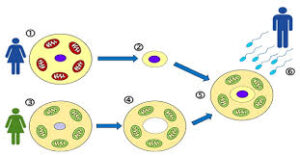
 Mitochondrial replacement therapy (MRT), also known as mitochondrial donation is an advanced reproductive technique designed to prevent the transmission of mitochondrial DNA (mtDNA) diseases from mother to child.
MRT involves replacing defective mitochondria in a woman’s egg with healthy mitochondria from a donor, enabling women with mitochondrial mutations to have genetically related children without passing on these disorders.
Two primary methods used in MRT:
Maternal Spindle Transfer (MST), where the nuclear DNA from the mother’s unfertilized egg is transferred into a donor egg that has had its nuclear DNA removed but retains healthy mitochondria.
This reconstructed egg is then fertilized and implanted.
Pronuclear Transfer (PNT):-Both the mother’s and the donor’s eggs are fertilized with sperm.
Before the eggs begin dividing, the genetic material,pronuclei, from the donor zygote is removed and replaced by that from the mother’s zygote, resulting in an embryo with the parents’ nuclear DNA and the donor’s healthy mitochondria.
A newer method, **Polar Body Transfer is also under investigation.
MRT provides a reproductive option for women at risk of transmitting severe mitochondrial diseases.
Mitochondrial diseases are rare but can be debilitating or fatal and replacing mutated mitochondria, MRT can break the cycle of inheritance for these conditions.
MRT remains prohibited in the United States due to regulatory restrictions.
MRT introduces complex questions about the modification of germline DNA and creates embryos with genetic contributions from three people—two mothers (nuclear and mitochondrial DNA) and one father (nuclear DNA).
Mitochondrial replacement therapy represents a significant advance in reproductive medicine, offering hope to families affected by mitochondrial diseases while also raising important scientific and ethical discussions for the future.
Mitochondrial replacement therapy techniques remove the nuclear DNA from an ooochte or a zygote carrying a pathogenic mtDNA variant and transfers them into a enucleated donor cell that provides wild type mtDNA.
This procedure provides hope for women with mtDNA disease who wish to have a biologically related child.
MRT often results in embryos with heteroplasmy, owing to a small but unavoidable amount of material mtDNA carryover during nuclear transfers, and this residual of contamination poses a risk of reversion.
The residual contamination poses a risk of reversion in which the carried over mtDNA expands and become a majority: metabolic disorders and development delays may occur in hetero plasmy.