
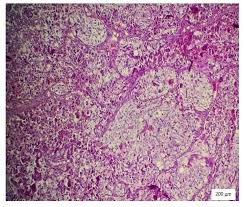
 Clear cell carcinoma (CCC) of the female general tract on rare lesions.
Clear cell carcinoma of the female general tract accounts for 5 to 20% about ovarian cancer and 5 to 10% of endometrial cancers.
Clear cell carcinomas of gynecological origin are rare, high-grade malignancies with site-specific differences in epidemiology, molecular biology, clinical presentation, prognosis, and management.
Malignancies of the genital tract, have a higher prevalence in Asian population, and our associated with thromboembolic complications and paraneoplastic hypercalcemia.
Molecular evidence exists that ovarian clear cell carcinoma arises in foci of endometriosis.
Patients with advanced clear cell carcinoma of the gynecological organs have a poor prognosis due to inherit resistance to platinum based and non-platinum based chemotherapy that results in poor survival compared with other types of ovarian and endment cancers.
Histologic prognostic factors are lacking and all clear cell GYN tumors are considered high grade.
Stage is the most important prognostic variable and most are diagnosed at stage I and cured with surgery.
For those with recurrent or metastatic disease, chemoresistance results in limited responses to second line interventions and poor overall survival.
Patients with advanced clear cell carcinoma of the gynecological organs produce multiple cytokines, coupled with intrinsic early emergence of resistance to conventional chemotherapy.
Ovarian cancer is characterized by high frequency of ARIDIA and PIK3CA variants that define other recurrent genomic aberrations.
Clear cell endometrial cancers have similar molecular profiles, but very at lower frequency than in clear cell ovarian cancers.
Ovarian clear cell carcinoma accounts for 5–15% of epithelial ovarian cancers in the United States and Europe, with a higher prevalence in East Asian populations, where it can reach up to 20% of epithelial ovarian cancers.
The median age at diagnosis is 56 years, and ovarian clear cell carcinoma (OCCC);is strongly associated with endometriosis, with over 50% of cases having a history of this condition.
The age-adjusted incidence rate ratio for OCCC in women with histologically proven endometriosis is 21.34 compared to controls, underscoring the magnitude of this risk factor.
Endometrial clear cell carcinoma (CCEC) comprises less than 10% of endometrial cancers in the United States, with an estimated incidence of 0.5–1 per 100,000 women-years.
CCEC is more common in older women (mean age 64.6 years) and is disproportionately seen in non-Hispanic Black women, who also have higher rates of advanced-stage presentation and poorer outcomes.
Cervical clear cell carcinoma (CCAC) is exceedingly rare, representing approximately 4% of cervical adenocarcinomas, with a historical association with in utero diethylstilbestrol (DES) exposure.
The cumulative risk of DES-related CCAC by age 50 is 1 per 750 exposed women, with a small second peak in incidence around age 42.
In the absence of DES exposure, CCAC remains extremely rare.
Primary clear cell adenocarcinoma of the vagina is also rare, comprising 5–10% of vaginal cancers, again with most cases linked to DES exposure.
Vulvar clear cell carcinoma is exceptionally rare, with only sporadic cases reported and no established risk factors.
CCCs across gynecological sites share distinctive molecular and pathological features.
CCCs tumors are characterized by clear or eosinophilic cytoplasm, prominent cell borders, and architectural patterns including tubulocystic, papillary, and solid growth.
Marked nuclear atypia and high mitotic activity are typical.
Immunohistochemically, CCCs are notable for strong expression of hepatocyte nuclear factor 1β (HNF1β) and napsin A, with HNF1β being a reliable marker across sites.
Napsin A is less sensitive in endometrial CCCs than in ovarian CCCs.
These tumors typically lack Wilms tumor 1 (WT1) expression, distinguishing them from serous carcinomas, and have low hormone receptor expression.
Molecularly, CCCs are defined by frequent mutations in ARID1A (50–87% in OCCC, 21–75% in CCEC) and PIK3CA (25–50% across sites), with additional alterations in PTEN, TP53 (up to 46% in CCEC), PPP2R1A, PIK3R1, SPOP, and FBXW7.
Copy number variations in genes such as NF1, ASXL1, TCF7L2, CREBBP, and LRP1B (gains), and ATM, FANCM, RB1, and FLT (losses) have been identified in OCCC.
Microsatellite instability (MSI) and mismatch repair (MMR) deficiency are present in 6–33% of cases, with MMR deficiency conferring increased tumor mutational burden and potential sensitivity to immune checkpoint inhibitors.
The clinical presentation of gynecological CCCs is nonspecific and overlaps with other gynecologic malignancies and benign conditions.
OCCC often presents with a pelvic or abdominal mass, pain, or symptoms of endometriosis, but CA-125 is frequently normal, especially in early-stage disease.
Most gynecological CCC’s are diagnosed as ovarian cancers in about half or associated with endometriosis.
Uterine CCC most commonly presents with abnormal uterine bleeding in older women and is associated with a higher stage at diagnosis and a more aggressive course.
Cervical CCC presents with abnormal bleeding or discharge but lacks distinguishing clinical/imaging features.
Vaginal and vulvar CCCs present with bleeding, discharge, or a mass, but diagnosis relies on histopathological evaluation.
Diagnostic challenges for clear cell Gyn cancers include the lack of pathognomonic symptoms, limitations of biomarkers (e.g., CA-125 is often normal in early OCCC), and histopathological overlap with other high-grade carcinomas and metastatic renal clear cell carcinoma.
Immunohistochemistry-HNF1β, napsin A.
Molecular testing for ARID1A, PIK3CA, and TP53 mutations, as well as assessment of MMR status, can provide additional diagnostic and prognostic information.
Clear cell carcinomas of the gynecologic tract are aggressive malignancies with site-specific differences in prognosis and clinical course.
OCCC, when diagnosed at early stage (FIGO I), has a 5-year overall survival (OS) rate exceeding 80%.
However, advanced-stage or recurrent OCCC is associated with poor prognosis due to intrinsic resistance to platinum-based chemotherapy, with response rates to first-line carboplatin-paclitaxel of only 25% and second-line chemotherapy responses below 10%.
The clinical course is marked by a high risk of thromboembolic events and hypercalcemia.
CCEC is associated with a 5-year OS ranging from 20% to 58%, with worse outcomes in older patients, advanced stage, deep myometrial invasion, and adnexal involvement.
Adjuvant therapy for all patients with stage IB or higher, with observation reserved for stage IA tumors without myometrial invasion.
Molecular profiling reveals frequent p53 abnormalities, PTEN loss, PIK3CA mutations, and MMR deficiency in up to 20% of cases, which may predict response to immunotherapy.
Cervical CCC is generally poor compared to HPV-associated adenocarcinomas, with 5-year OS rates around 88% for early-stage disease, but outcomes decline sharply with advanced stage, lymph node involvement, or deep stromal invasion. Recurrence rates are high, and death from disease occurs in up to 19% of cases.
Vaginal and vulvar CCCs are exceedingly rare, with limited data.
Vaginal CCC tends to present with early lymph node involvement, which portends a worse prognosis.
Radiation therapy has historically been used, but late recurrences are common, and overall survival is limited.
Vulvar CCC has a 5-year survival rate of approximately 20% in recurrent or metastatic cases.
The standard management of gynecological CCCs is site-specific surgical resection followed by adjuvant platinum-based chemotherapy and/or radiation.
For OCCC, primary debulking surgery followed by platinum-based chemotherapy (carboplatin and paclitaxel) is standard, but the objective response rate (ORR) to first-line chemotherapy is only about 25%, and second-line chemotherapy yields ORRs below 8%.
For CCEC, surgical management with total hysterectomy and bilateral salpingo-oophorectomy, often with lymphadenectomy, is the mainstay for localized disease.
Adjuvant therapy is frequently considered due to the high risk of recurrence, even in early-stage disease.
Type II endometrial cancers,including clear cell carcinoma,have a worse prognosis and higher recurrence risk than endometrioid histology.
Randomized trials have not demonstrated a clear survival benefit for adjuvant chemotherapy in this subgroup.
Cervical, vaginal, and vulvar CCCs are managed according to site-specific protocols for non-clear cell histologies, with surgery as the primary modality for localized disease and chemoradiation for locally advanced or unresectable tumors.
The role of adjuvant chemotherapy or radiation is extrapolated from broader studies, and there is no evidence to support a clear cell-specific approach.
Immunotherapy has shown promise in the management of advanced or recurrent gynecological CCCs.
The combination of PD-1/PD-L1 inhibitors with anti-angiogenic agents, such as lenvatinib or bevacizumab, has also shown promise.
In OCCC, the benefit of adjuvant chemotherapy in early-stage disease, the use of fertility-sparing surgery, and the role of targeted therapies remain unresolved. In CCEC, the necessity and efficacy of adjuvant therapy, the integration of molecular classification, and the potential for treatment de-escalation in select patients are active areas of debate.
Hereditary cancer syndromes, particularly Lynch syndrome and BRCA mutations, play a significant role in the development and management of clear cell carcinomas, especially in the ovary and endometrium.
Routine MMR immunohistochemistry or MSI testing is recommended for newly diagnosed cases of endometrioid or clear cell ovarian carcinoma, and germline and somatic BRCA testing should be performed in all epithelial ovarian cancers, including clear cell carcinoma.
The identification of these syndromes informs risk-reducing strategies, genetic counseling, surveillance, and therapeutic decision-making, including the use of immune checkpoint inhibitors in MMR-deficient tumors.
In pediatric and adolescent populations, CCCs most commonly present as CCAC or CCAV, with abnormal vaginal bleeding as the predominant symptom.
Diagnosis is often delayed due to nonspecific presentation.
Management includes the need for oncologic cure with fertility preservation and minimization of long-term morbidity.
Fertility-sparing surgery, neoadjuvant and adjuvant chemotherapy, and chemoradiation are all described, but there is no consensus on optimal therapy.
Outcomes are variable, with early-stage disease amenable to cure but advanced disease associated with poor prognosis.
Surveillance strategies for patients with gynecological CCCs are concern ed by the aggressive nature and high recurrence risk of these tumors.
Most recurrences occur within the first two to three years post-treatment.
The highest hazard for progression and death observed in the first 12–24 months, particularly for OCCC and CCEC.
Supportive care is critical due to the substantial morbidity associated with both the disease and its treatment.
There are global and racial/ethnic disparities in the incidence, management, and outcomes of clear cell gynecological cancers.
OCCC is more common in East Asian populations, while CCEC disproportionately affects non-Hispanic Black women in the United States, who also experience worse survival outcomes.
Clear cell carcinomas of the vagina and vulva are among the rarest gynecologic malignancies.
Surgery remains the primary modality for localized disease, with radiation and chemoradiation reserved for advanced cases.
Chemotherapy is of limited efficacy in CCCs
Outcomes are generally poor in advanced or recurrent disease.
Early-stage OCCC and CCEC have relatively favorable outcomes, but advanced or recurrent disease is associated with poor survival due to chemoresistance.
Immunotherapy, particularly dual checkpoint blockade, is rapidly reshaping the therapeutic landscape, offering improved response rates and durability in advanced disease.
Nivolumab and ipilimumab combination therapy has significant activity in GYN clear cell cancers.