
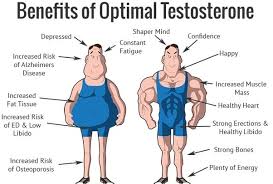
 Testosterone preparations have been approved to treat hypogonadism and are effective incorrect the clinical abnormalities associated with this condition in many men.
However, most men currently treated with testosterone preparations are middle aged or older, and have only moderate decreased testosterone levels, a high burden of chronic diseases, and nonspecific symptoms overlapping with age related symptoms.
The benefits and risk of testosterone treatment in this age group is less clear and associated with significant controversy.
Varying studies have demonstrated the most consistent benefit of testosterone treatment in men with hypogonadism was improved sexual function.
In the Testosterone Trials, testosterone treatment increased sexual activity by approximately 40%, libido by approximately 25%, and erectile function by approximately 35%.(In adults 57 to 85 years of age, approximately 50% of participants 75 to 85 years of age reported sexual activity with the partner two or three times each month).
In the TRAVERSE trial testosterone treatment was also associated with increased sexual activity and libido, but did not improve erectile function.
Testosterone treatment is associated with modest improvements in physical function based on reported or performance based measures of walking, or stair climbing ability, and improve the perception of overall physical function.
In the TRAVERSE trial almost half of the participants reported depressive symptoms and nearly 10% reported severe depressive symptoms.
Testosterone treatment generally increases the hemoglobin level, about 1 g/dL.
Testosterone treatment improves bone density, and architecture as one year treatment was associated with increased the volumetric bone mineral density and bone strength, and an estimated quantity by computed tomography of 7% in traneculst bone of the spine and less but significant in peripheral bone.
Testosterone therapy for two years, is associated with increased cortical bone in the tibia and radius.
Testosterone treatment that increases your testosterone level to the middle of the normal range and little effect on glucose metabolism.
Testosterone treatment does not appear to improve cognition in men who do not have pre-existing cognitive disease.
Studies are conflicting when it comes to whether testosterone treatment increases cardiovascular risk.
In the TRAVERSE trial, major adverse cardiac effects (MACV) and coronary revascularization procedures were similar in testosterone and placebo groups: thus among men with high risk of pre-existing cardiovascular disease, the incidence of major adverse cardiac events with testosterone treatment was similar to placebo.
The majority of reported cases of venous thromboembolic events during testosterone treatment have occurred in men with thrombophilia.
Some trials have suggested an increased risk of venous thromboembolism with testosterone treatment during the first six months of treatment.
There has not been shown a consistent relationship between testosterone treatment, and the risk of atrial fibrillation.
Erythrocytosis is associated with testosterone levels that are at the high end of the normal range or higher during treatment.
The incidence of erythrocytosis is higher when injectable testosterone is used , as higher levels of testosterone esters be reached.
A physiological dose of testosterone is an uncommon cause of erythrocytosis.
In testosterone trials men with an elevated PSA were excluded so that there was no evidence for increased risk of prostate cancer in such treated men.
Testosterone treatment increases PSA levels and increases the likelihood of a prostate biopsy will be performed, which in turn increases the risk of detecting low-grade prostate cancer.
In the TRAVERSE trial, the incidence of invasive procedure for BPH in the testosterone group was twice as high as that in the placebo group,
In the TRAVERSE trial, the incidence of acute urinary retention and initiation of new pharmacologic treatment for BPH did not differ with testosterone or placebo groups.
Testosterone trials showed that the lower urinary tract symptoms did not differ among groups.
While testosterone treatment in men with hypogonadism improves bone density and architecture, the TRAVERSE trial was associated with an increase in fracture risk.
Testosterone treatment increases bone mineral density, volumetric bone, mineral density, and estimate of bone strength in the spine and the hip: but in the TRAVERSE trial, there was a 43% increase in the incidence of clinical bone fractures.
The most common fractures involved the ankle, wrist and ribs.
Testosterone treatment in middle aged and older men with hypogonadism improves libido, sexual activity, and erectile function, and is associated with improvement in anemia, slight decreases in depression, and slight improvements in mood, energy, and walking ability.
Testosterone treatment in this age group increases the risk of pulmonary embolism and it may increase the risk of atrial fibrillation.
Testosterone treatment does not increase the risk of major adverse, cardiac events, lower urinary tract symptoms or prostate cancer.
The decision of whether to recommend testosterone treatment is based on balances of benefits and risks.