
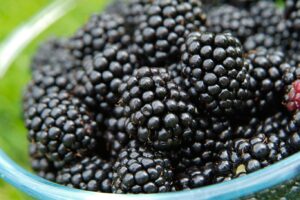
 The blackberry is an edible fruit produced by many species in the genus Rubus in the family Rosaceae.
Rubus armeniacus is considered a noxious weed and invasive species in many regions of the Pacific Northwest of Canada and the United States, where it grows out of control in urban and suburban parks and woodlands.
The blackberry looks similar to its raspberry relatives.
What distinguishes the blackberry is the connection between the berry and the torus (receptacle or stem).
When a raspberry is picked, the torus remains on the vine.
This is why there is a hollow core in the raspberry fruit.
When a blackberry is picked, the torus stays with the fruit.
The usually black fruit is not a berry in the botanical sense, as it is termed botanically as an aggregate fruit, composed of small drupelets.
It is a widespread and well-known group of over 375 species.
The flowers bloom in late spring and early summer on the tips of branches.
Blackberry fruits are red when unripe.
Nutritional value per 100 g (3.5 oz) Energy 180 kJ (43 kcal) Carbohydrates 9.61 g Sugars 4.88 g Dietary fiber 5.3 g Fat 0.49 g Protein 1.39 g Water 88 g
Nutrients Raw blackberries are 88% water, 10% carbohydrates, 1% protein, and 0.5% fat.
In a reference amount of 100 grams (3.5 oz), raw blackberries supply 43 calories, and are a rich source (20% or more of the Daily Value, DV) of dietary fiber, manganese (28% DV), and vitamin C (23% DV), with a moderate amount of vitamin K (17% DV).
Blackberries contain numerous large firm seeds containing omega-3 (alpha-linolenic acid) and omega-6 (linoleic acid) fats, protein, dietary fiber, carotenoids, ellagitannins, and ellagic acid.
The ripe fruit is commonly used in desserts, jams, jelly, wine, and liqueurs. It may be mixed with other berries and fruits for pies and crumbles.
Blackberries contain numerous phytochemicals including polyphenols, flavonoids, anthocyanins, salicylic acid, ellagic acid, and fiber.
Anthocyanins in blackberries are responsible for their rich dark color.
In the culinary world, blackberries have long been used alongside other fruits to make pies, jellies, and jams.
Blackberry fruit, leaves, and stems have been used to dye fabrics and hair.
Blackberries are nutrient-dense berries with several health benefits:
Very high in fiber-About 8 grams per cup, supporting digestive health Low in calories-Around 60 calories per cup Rich in vitamins-Excellent source of vitamin C and K Minerals-Manganese, copper, and folate
Blackberries are loaded with anthocyanins, which give them their dark color, and other antioxidants that help protect cells from oxidative stress and may reduce chronic disease risk.
The antioxidants in blackberries may help improve cognitive function and slow age-related cognitive decline, suggesting they support memory and motor skills.
The fiber, antioxidants, and anti-inflammatory compounds may help lower blood pressure, reduce cholesterol, and decrease cardiovascular disease risk.
Despite their sweetness, blackberries have a low glycemic index and their fiber content helps regulate blood sugar levels, making them a good choice for diabetes management.
High vitamin C content supports immune function and helps fight infections.
The high fiber content promotes healthy gut bacteria and regular bowel movements.