
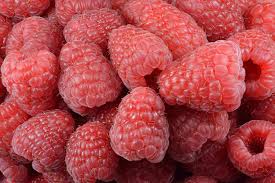
 The raspberry is the edible fruit of several plant species in the genus Rubus of the rose family, most of which are in the subgenus Idaeobatus.
Raspberries are perennial with woody stems
Raspberries are cultivated across northern Europe and North America and are consumed in various ways, including as whole fruit and in preserves, cakes, ice cream, and liqueurs.
A raspberry is an aggregate fruit.
It develops from the numerous distinct carpels of a single flower.
Each carpel then grows into individual drupelets, which, form the body of a single raspberry fruit.
As with blackberries, each drupelet contains a seed.
What distinguishes the raspberry from its blackberry relatives is whether or not the torus, receptacle or stem, stays with the fruit.
With the blackberry fruit, the torus stays with the fruit.
With a raspberry, the torus remains on the plant, leaving a hollow core in the raspberry fruit.
An individual raspberry weighs 3–5 g (1⁄8–3⁄16 oz) and is made up of around 100 drupelets.
A raspberry bush can yield several hundred berries a year.
They are easy to grow and tends to spread unless pruned.
Escaped raspberries frequently appear as garden weeds, spread by seeds found in bird droppings.
Raspberries are grown for the fresh fruit market and for commercial processing into individually quick frozen fruit, purée, juice, or dried fruit used in a variety of grocery products such as raspberry pie.
Raspberries spread well, and can take over gardens if left unchecked.
Raspberries are often propagated using cuttings, and will root readily in moist soil conditions.
Raspberries, raw Nutritional value per 100 g (3.5 oz) Energy 220 kJ (53 kcal) Carbohydrates 11.94 g Sugars 4.42 g Dietary fiber 6.5 g Fat 0.65 g Protein 1.2 g Vitamins and minerals Other constituents Quantity Water 85.8 g
Raw raspberries are 86% water, 12% carbohydrates, and have about 1% each of protein and fat.
In a reference amount of 100 g (3.5 oz), raspberries supply 53 kilocalories and 6.5 grams of dietary fiber.
Raspberries are a rich source of vitamin C (29% of the Daily Value, DV), manganese (29% DV), and dietary fiber (6.5 grams), but otherwise have low content of micronutrients.
Raspberries contain phytochemicals, such as anthocyanin pigments, ellagic acid, ellagitannins, quercetin, gallic acid, cyanidins, pelargonidins, catechins, kaempferol and salicylic acid.
Yellow raspberries and others with pale-colored fruits are lower in anthocyanin content.
Both yellow and red raspberries contain carotenoids, mostly lutein esters, but these are masked by anthocyanins in red raspberries.
Raspberry leaves can be used fresh or dried in herbal teas, providing an astringent flavor. In herbal and traditional medicine, raspberry leaves are used for some remedies, although there is no scientifically valid evidence to support their medicinal use.