
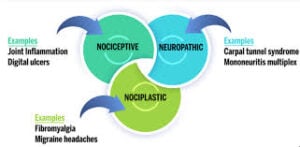
 Fibromyalgia is the classic example of nociplastic pain, being diagnosed when pain is felt in four different quadrants of the body.
Nociplastic pain, formerly known as central sensitisation, is chronic pain that persists without evidence of tissue injury, resulting in and being sustained by aberrant or heightened pain signal processing of the central nervous system (CNS).
Nociplastic pain may occur in combination with the other types of pain or in isolation.
The pain may be generalised or multifocal, and it can be out of proportion to any associated physical cause.
This type of pain typically arises in some chronic pain conditions.
The archetypal condition being fibromyalgia.
Exercise, psychotherapy, and medical therapies are commonly prescribed for such conditions.
Nociplastic pain may play a role in the persistence of medically unexplained symptoms.
Nociplastic pain is a longterm complex pain that arises from altered nociception despite no clear evidence of actual or threatened tissue damage causing the activation of peripheral nociceptors or evidence for disease or lesion of the somatosensory system causing the pain.
It is the third proposed mechanism for pain, with other two mechanisms are nociceptive pain and neuropathic pain.
It is suggested that central sensitization is one of the significant mechanisms that contributes to nociplastic pain.
Central sensitization refers to a hyperexcitability of the nervous system, usually including hyperalgesia and allodynia, the painful perception of non-painful stimuli.
The causes of nociplastic pain are is thought to be a dysfunction of the central nervous system’s processing of pain signals, which may have become distorted or sensitized..
Proposed mechanisms for nociplastic pain, such as increased integration between parts of the brain responsible for emotion, sensory processing, and attention, increased levels of pain-inciting neurotransmitters, increased immune activity in the central and peripheral nervous systems, and alteration in muscle structure, such as the formation of myofascial trigger points.
Specific central nervous system locations that have been suggested to be the location of the dysfunction are nociceptive neurons, spinal and supraspinal structures, the dorsal horn, and others.
Chronic pain syndromes, such as irritable bowel syndrome, can potentially be triggered by viral illnesses or bacterial infections in some patient populations.
Infections may increase levels of inflammatory mediators, leading to pain receptor hyper-sensitization and the development of nociplastic pain.
Nociplastic pain is characterized by pain that is isolated to one bodily region or widespread to several bodily regions, along with a poor response to conventional painkillers.
The painful areas may experience pain out of proportion to temperature stimuli and applied pressure.
While the pain often manifests somatically, it can also present viscerally: chronic primary bladder pain syndrome has been shown to potentially have a nociplastic pain component.
There may be additional CNS-associated symptoms, such as fatigue, executive dysfunction, mood disturbances, and sleep problems.
Nociplastic pain can occur on its own in conditions like tension headache or fibromyalgia or arise as a part of other pain categories, such as chronic back pain.
Certain risk factors, such as being female, genetic factors, environmental factors, childhood trauma, physical inactivity, a past medical history of depression, anxiety, and panic disorder, and increased awareness of one’s bodily sensations.
There is a potential correlation between having an autoimmune disease and developing fibromyalgia, the most typical condition of nociplastic pain.
The majority of the pain in autoimmune disorders is thought to be primarily inflammatory, these studies possibly point to a nociplastic origin of pain in this population, which could improve the treatment of the debilitating pain patients with autoimmune conditions experience.
Diagnosis often starts with excluding other medical conditions.
Among the criteria is the presence of other central nervous system disturbances such as sleep disturbances and fatigue.
Other tools to measure central sensitization include quantitative sensory testing, functional magnetic resonance imaging (fMRI), EMG, brain mapping, and measures of cytokines and neurotrophines in the blood and urine.
The treatment of nociplastic pain is often multifaceted requiring both physical and psychological therapies, pain neuroscience education, and sometimes pharmacological therapy.
Treatment available that can help manage nociplastic pain:
Exercise is commonly recommended because regular exercise increases the release of mood-elevating neurotransmitters and decreases inflammatory cells in the central nervous system.
Transcutaneous electrical nerve stimulation (TENS) also helps to reduce pain by acting on inhibitory spinal cord receptors and activating pain-reducing receptors in the brain.
Psychotherapy can also help patients with nociplastic pain to retrain their interpretation of and reaction to pain, improving quality of life.
Conventional pain management medications such as NSAIDs and opioids have shown limited usefulness in managing nociplastic pain. Currently, SNRI and TCA antidepressants are recommended, but their utility in managing this condition remains unclear.
Nociplastic pain is defined as pain that arises from altered nociceptive processing.
There is absence of clear evidence of actual or threatened tissue damage or disease of the somatosensory system that would explain the pain.
Nociceptive pain is caused by tissue injury or inflammation and neuropathic pain is caused by nerve damage.
Nociplastic pain is characterized by widespread or multifocal pain that is disproportionate to any identifiable peripheral pathology.