
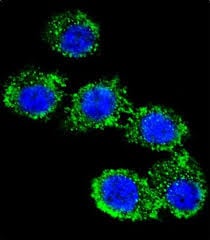
Complement decay-accelerating factor, also known as CD55 or DAF, is a protein that, in humans, is encoded by the CD55 gene.
CD55 protects cells from damage by their own complement system.
It accelerates the decay of C3 and C5 convertases, which are enzyme complexes that can cause cell destruction if not properly regulated.
It is found on the surface of most human cells, including blood cells, endothelial cells, and epithelial cells.
DAF regulates the complement system on the cell surface.
DAF recognizes C4b and C3b fragments that are created during activation of C4 with the classical or lectin pathway or C3 of the alternative pathway.
DAF limitS the amplification convertases of the complement cascade,
DAF indirectly blocks the formation of the membrane attack complex.
DAF glycoprotein is broadly distributed among hematopoietic and non-hematopoietic cells.
DAF is a 70 kDa membrane protein that attaches to the cell membrane via a glycophosphatidylinositol (GPI) anchor.
Because DAF is a GPI-anchored protein, its expression is reduced in persons with mutations that reduce GPI levels such as those with paroxysmal nocturnal hemoglobinuria (PNH).
In PNH disorder, red blood cells with very low levels of DAF and CD59 undergo complement-mediated hemolysis.
Symptoms include anemia, fatigue, and episodes of dark colored urine and other complications.
Binding of DAF to human HIV-1 when the virons are budding from the surface of infected cells protects HIV-1 from complement mediated lysis.
CD55 refers to Decay Accelerating Factor (DAF), a glycoprotein that plays an important role in the complement system – part of our immune system’s defense mechanism.