
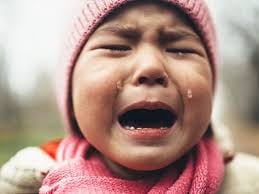
 Crying is the dropping of tears, or welling of tears in the eyes, in response to an emotional state or physical pain.
Emotions that can lead to crying include sadness, anger, joy, and fear.
Crying can also be caused by relief from a period of stress or anxiety, or as an empathetic response.
The act of crying is a complex secretomotor phenomenon characterized by the shedding of tears from the lacrimal apparatus, without any irritation of the ocular structures, instead, giving a relief which protects from conjunctivitis.
A related medical term is lacrimation, which also refers to the non-emotional shedding of tears.
Various forms of crying are known as sobbing, weeping, wailing, whimpering, bawling, and blubbering.
For crying to be described as sobbing, it usually has to be accompanied by other symptoms, such as slow but erratic inhalation, occasional instances of breath holding, and muscular tremor.
A neuronal connection between the lacrimal gland and the areas of the human brain involved with emotion has been established.
Tears produced during emotional crying have a chemical composition which differs from other types of tears.
They contain significantly greater quantities of the hormones prolactin, adrenocorticotropic hormone, and Leu-enkephalin, and the elements potassium and manganese.
The question of the function or origin of emotional tears: Theories it is a response to inflicted pain, to the more complex, including nonverbal communication in order to elicit altruistic helping behavior from others, to serve several biochemical purposes, such as relieving stress and clearance of the eyes.
Some empirical evidence exists that crying lowers stress levels, potentially due to the release of hormones such as oxytocin.
Crying is believed to be an outlet or a result of a burst of intense emotional sensations, such as agony, surprise, or joy and could explain why people cry during cheerful events, as well as very painful events.
People tend to remember the positive aspects of crying, and may create a link between other simultaneous positive events, such as resolving feelings of grief.
These features of memory reinforce the idea that crying helped the individual.
Psychological theories of crying emphasize the relationship of crying to the experience of perceived helplessness, and it is the underlying experience of helplessness that can usually explain why people cry.
One study proposes crying, by blurring vision, can handicap aggressive or defensive actions, and may function as a signal of appeasement, need, or attachment.
Some believe crying shows vulnerability and submission to an attacker, solicits sympathy and aid from bystanders, and signals shared emotional attachments.
Studies have shown several physical effects of crying, such as increased heart rate, sweating, and slowed breathing.
The type of effects an individual experiences with crying depends largely on the individual, for many it seems that the calming effects of crying, such as slowed breathing, outlast the negative effects, which could explain why people remember crying as being helpful and beneficial.
The most common side effect of crying is feeling a lump in the throat of the crier, known as a globus sensation.
A globus sensation experienced in crying is a response to the stress experienced by the sympathetic nervous system of fight or flight.
Another function increased by the sympathetic nervous system is breathing, which includes opening the throat by expanding the glottis to increase air flow.
Following this sympathetic response, eventually the parasympathetic nervous system attempts to undo the response by decreasing high stress activities and increasing recuperative processes, which includes digestion, which requires closing the fully expanded glottis to prevent food from entering the larynx.
The glottis attempts to remain open as an individual cries.
This fight to close the glottis creates a sensation that feels like a lump in the individual’s throat.
Other common side effects of crying include quivering lips, a runny nose, and an unsteady, cracking voice.
According studies on crying, the average woman cries between 30 and 64 times a year, and the average man cries between 6 and 17 times a year.
Men tend to cry for between two and four minutes, and women cry for about six minutes.
Crying turns into sobbing for women in 65% of cases, compared to just 6% for men.
Before adolescence, no difference between the sexes was found.
The gap between how often men and women cry is larger in countries that have more wealth, democracy, and gender egalitarianism.
Infants can shed tears at approximately four to eight weeks of age.
Crying is critical to when a baby is first born, signaling they can breathe on their own and reflects they have successfully adapted to life outside the womb.
There are three different types of cries apparent in infants.
A basic cry, which is a systematic cry with a pattern of crying and silence.
The basic cry starts with a cry coupled with a briefer silence, which is followed by a short high-pitched inspiratory whistle.
Then, there is a brief silence followed by another cry.
Hunger is a main stimulant of the basic cry.
An anger cry is much like the basic cry; in this cry, more excess air is forced through the vocal cords, making it a louder, more abrupt cry.
An anger cry is characterized by the same temporal sequence as the basic pattern but distinguished by differences in the length of the various phase components.
The third cry is the pain cry, which, unlike the other two, has no preliminary moaning.
The pain cry is one loud cry, followed by a period of breath holding.
Most adults can determine whether an infant’s cries signify anger or pain.
Most parents also have a better ability to distinguish their own infant’s cries than those of a different child.
There is a correlation between the mother’s prenatal stress level and later amount of crying by the infant.
There is a correlation between birth trauma and crying.
Mothers who had experienced obstetrical interventions or who were made to feel powerless during birth had babies who cried more than other babies.
Babies who had experienced birth complications had longer crying spells at three months of age and awakened more frequently at night crying.
Some parents with experience of children are better at identifying types of cries than those who do not have experience of children.
Temporal perspectives of crying: In temporal perspective, sorrowful crying is due to looking to the past with regret or to the future with dread.
Crying as a result of happiness would then be a response to a moment as if it is eternal; the person is frozen in a blissful, immortalized present.
Crying due to a loss is a message to the outside world that pleads for help with coping with internal sufferings.
Sorrowful crying is a method of self-pity or self-regard, a way one comforts oneself.
Joyful crying, in contrast, is in recognition of beauty, glory, or wonderfulness.
There are three types of tears: basal tears, reflexive tears, and psychic tears.
Basal tears are produced at a rate of about 1 to 2 microliters a minute.
Basal tears are made in order to keep the eye lubricated and smooth out irregularities in the cornea.
Reflexive tears are tears that are made in response to irritants to the eye: chopping onions or getting poked in the eye.
Psychic tears are produced by the lacrimal system and are the tears expelled during emotional states.