
 Historically considered benign.
Refers to thrombosis of any segment of the superficial vein system,typically in the lower or upper extremities.
Superficial vein thrombosis has an estimated annual incidence of 64 to 131 per 100000 years.
Superficial sin thrombosis is most common in the great saphenous and smallsaphenous veins of the lower extremities and the basilic and cephalic veins of the upper extremities.
Superficial vein thrombosis can also manifest in the chest wall, breasts or penis.
If untreated, the 45 day incidence of DVT, or pulmonary embolism and extension of superficial vein thrombosis in patients with lower extremity superficial vein thrombosis can be as high as 1.3 and 3.4%, respectively
Approximately 10% of patience with superficial venous thrombosis progressed a deep vein thrombosis or pulmonary embolism.
Evidence accumulating that it may lead to deep vein thrombophlebitis by direct extension into deep venous system.
Clinical risk factors for lower extremity superficial venous thrombosis are similar to those of DVT and PE and include: pregnancy, varicose veins, and active cancer.
Progression of superficial venous thrombosis of the lower extremities associated with significant risk of deep vein thrombosis and pulmonary embolism regardless of the proximity to the saphenofemoral venous junction (Leizorovicz A et al).
Superficial thrombophlebitis (SVT) is a thrombosis and inflammation of superficial veins.
It can develop along the arm, back, or neck veins, but the leg is by far the most common site of involvement.
Upper extremity superficial venous thrombosis is primarily caused by indwelling intravenous catheters.
When it occurs in the leg, the great saphenous vein is usually involved.
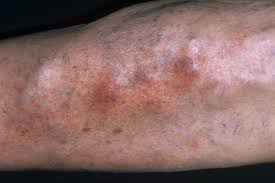
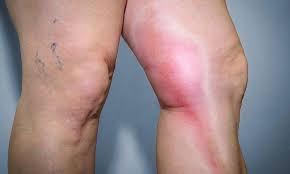
It presents as a painful induration with erythema.
It presents as a linear or branching configuration forming cords.
It is due to inflammation and/or thrombosis, and less commonly infection of the vein.
It is generally a benign, self-limited disorder.
Some 125,000 cases a year have been reported in the United States, but actual incidence is unknown.
There is a fourfold increased incidence from the third to the eight decade in men.
There is preponderance among women of approximately 55-70%.
The average age of affected patients is 60 years.
It can be complicated by deep vein thrombosis (DVT) and pulmonary embolism.
Migratory superficial thrombophlebitis is known as Trousseau’s syndrome.
Diagnosis is established by findings of tenderness, induration, pain, erythema along the course of a superficial vein, especially in patients with known risk factors.
Evaluation includes a history and physical exam, CBC with platelet count, prothrombin time, activated partial thromboplastin time, liver, and kidney function tests, as well as a venous ultrasound, especially if the possibility of proximal deep vein involvement exists.
Often a palpable, sometimes nodular cord, due to thrombus within the affected vein can be palpated.
If such a cord persists when the extremity is raised the presence of thrombus is suggested.
If erythema extends significantly beyond the margin of the vein it is possible that suppurative thrombophlebitis is present.
Suppurative thrombophlebitis is commonly associated with significant fever, and may require antibiotic treatment, surgical drainage and potentially vein excision.
Venous thromboembolism can occur with superficial vein thrombosis.
The percentage of patients with superficial thrombophlebitis that also have deep vein thrombophlebitis varies between 6% and 53%.
Pulmonary embolism has been reported in 0% to 10% of patients with superficial vein thrombosis.
Predisposing factors for superficial vein thrombosis is the same as for DVT: abnormalities of coagulation or fibrinolysis, endothelial dysfunction, infection, venous stasis, intravenous therapy and intravenous drug abuse.
Duplex ultrasound can identify the presence, location and extent of venous thrombosis.
Ultrasound is indicated: if superficial phlebitis involves or extends into the proximal one-third of the medial thigh, there is evidence for clinical extension of phlebitis, lower extremity swelling is greater than would be expected from a superficial phlebitis alone or diagnosis of superficial thrombophlebitis in question.
D-dimer testing has a sensitivity of approximately 48 to 74% and is not reliable for excluding superficial venous thrombosis.
Approximately 25% of patients with lower extremity superficial venous thrombosis present with DVT, likely because risk factors for both processes are similar, and because superficial venous thrombophlebitis can extend into deep veins.
Treatment of superficial thrombophlebitis:
SVT involving the upper extremity if a peripheral catheter is involved and is no long longer indicated, the first step is to remove the catheter.
Symptomatic treatment involving warm compresses, elastic compression stockings, non-steroidal anti-inflammatory drugs, and elevation of the effected limb should be used as clinically indicated.
If symptomatic progression or progression on imaging occurs, prophylactic dose anticoagulation is recommended.
For lower extremity SVT prophylactic dose anticoagulation is recommended for at least six weeks if SVT is greater than 5 cm in length or if SVT extends above the knee.
Compression stockings should be offered to patients with lower extremity superficial phlebitis.
Compression stockings may reduce swelling and pain once the acute inflammation subsides.
Nonsteroidal anti-inflammatory drugs (NSAID) are effective in relieving the pain.
Anticoagulation for patients with lower extremity superficial thrombophlebitis at increased risk for thromboembolism, such as those with an affected venous segment of ≥5 cm, in proximity to deep venous system, positive medical risk factors.
Surgery is reserved for clot extension to within 1 cm of the saphenofemoral junction in patients deemed unreliable for anticoagulation, or have failed anticoagulation.
Ligation of saphenofemoral junction or stripping of thrombosed superficial veins are associated with higher rates of venous thromboembolism compared with treatment with anitcoagulants.
Up to 29% of patients with acute superficial venous thrombosis of the lower extremity have associated deep vein thrombosis or symptomatic pulmonary embolism.
Approximately 125,000 cases reportedly annually, but incidence of spontaneous phlebitis is unknown as the disease may resolve without intervention and may go unrecognized.
Predominates among females 55-70%.
Fourfold increase in incidence among men from third to the eighth decades.
Mean age of onset 60 years.
Any superficial vein may be affected.
Exercise and trauma may be implicated in onset, but commonly no specific etiology can be identified.
Most commonly associated with intravenous catheter placement.
May be associated with breast cancer.
Leg most common site of involvement.
In addition to the leg may involve the arm, neck, thorax.
May be associated with chemotherapy infusions or drug abuse.
The great saphenous vein most common site of involvement in the leg.
Bilateral involvement in the leg 5-10% of cases.
Especially associated with varicose veins.
SVT appears to be more common then deep vein thrombophlebitis.
In a placebo controlled trial fondaparinux at 2 1/2 mg subcutaneous daily for 45 days reduced the probability that a superficial vein thrombosis of the leg would progress to deep vein thrombosis or pulmonary embolism, 1.3% with placebo versus at 0.2% with fondaparinux (Decousus H et al). will
Low molecular weight heparin and nonsteroidal anti-inflammatory drugs decrease the rate of superficial thrombophlebitis extension or recurrence versus placebo.