
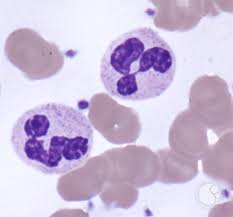
 Known as polymorphonuclear leukocytes originate from bone marrow stem cells.
Represent 60-70% of total circulating leukocytes.
The absolute number of circulating neutrophils measured in a routine blod test reflects a small number of he available pool of biologically active cells.
Approximately half of the biologic pool of neutrophils outside the marrow are circulating and the other half marginated to vascular endothelium (Athens JW).
A large reserve of mature neutrophils exist in the bone marow before exiting into the peripheral blood.
Circulating neutrohils comprise approximately 4.5% of mature bone marrow neutrophils, and 1.7% of total marrow granulocytes.
The average lifespan of inactivated human neutrophils in the circulation has been reported by different approaches to be between 5 and 135 hours.
Minor reduction in peripheral blood neutrophil counts do not increase risk of infection (Haddy, TB, Crosby WH)
First cells recruited to sites of infection or injury which can occur minutes to hours after reaching maturation.
Neutrophils are a key, secondary host defense, as they differentiate and mature in the bone marrow, circulate in the blood, marginate on the endothelial layer, and extravasate from the blood vessel, whereupon they travel to sites of inflammation or infection.
At sites of infection, the neutrophil activates and kills the pathogen by phagocytosis and releases reactive oxygen species, degranulates, and forms neutrophil extracellular traps: weblike structures made of DNA.
Neutrophil serine proteases such as neutrophil elastase are a key component of these processes and are mainly stored within the primary granules of the neutrophil.
In the bone marrow, during differentiation of neutrophils, protease precursors within these granules are cleaved and converted to functional enzymes by dipeptidyl peptidase 1.
Anti-proteases such as α-1 anti-trypsin, secretory leukocyte protease inhibitor, elafin , and alpha2 macroglobulin keep these proteases in check at sites of infection.
The main anti-protease is α-1 anti-trypsin one produced mainly by the liver.
A primary defense against infections and foreign substances that invade the body’s physical barriers.
Recruited to inflamed tissue by endothelial adhesion molecules and chemoattractants.
The net accumulation of neutrophils at sites of inflammation is a function of recruitment and median neutrophil lifespan.
Neutrophil apoptosis, or programmed cell death, is vital in controlling the duration of the early inflammatory response, thus restricting damage to tissues by the neutrophils.
Hypoxia increases neutrophil survival suggesting that that process may impair resolution of neutrophilic inflammatory processes such as acute respiratory distress syndrome, bronchiolitis organizing pneumonia and respiratory syncytial virus infection.
After docking to the endothelial surface which is mediated by selectins and leukocyte integrins, leukocytes transmigrate through blood vessel wall by diapedesis.
Eliminates invading organisms by phagocytosis, generates reactive oxygen metabolites, releases proteolytic enzymes and microbicidal substances stored in intracellular granules of mature cells.
Involved in transfusion related acute lung injury by endothelial activation which synthesizes chemokines and increases surface expression of adhesion molecules that cause polymorphonuclear adhesion and release of microbicidal agents that damage the endothelium, cause capillary leak and lung damage.
Smoking stimulates leukocyte counts.