
 The Cox Maze procedure, also known as Maze procedure, is a type of heart surgery for atrial fibrillation.
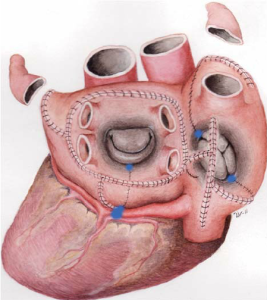
Refers to the series of incisions arranged in a maze-like pattern in the atria.
An open-heart cardiac surgery procedure intended to eliminate atrial fibrillation.
The procedure refers to the series of incisions arranged in a maze-like pattern in the atria.
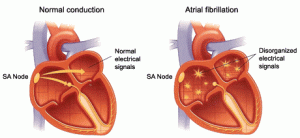
Incisional scars block abnormal electrical circuits of atrial macroreentry that initiate and perpetuate the abnormal electrical waves of AF.
Creating Scars: The surgeon makes precise lines of scar tissue using either traditional incisions (the “cut-and-sew” technique) or energy sources such as radiofrequency (heat) or cryoablation (extreme cold).
Redirecting Electrical Signals: Because scar tissue does not conduct electricity, these lines act as barriers.
They block the chaotic electrical impulses that cause AFib and force normal signals to follow a single, controlled path to the lower heart chambers.
Stroke Prevention: Surgeons typically remove or close the left atrial appendage (LAA) during the procedure. This is a small pouch where 90% of stroke-causing blood clots form in patients with AFib.
Traditional (Open) Maze: Performed through a long incision in the chest (sternotomy). This usually requires a heart-lung bypass machine to keep blood flowing while the heart is stopped.
Mini-Maze (Minimally Invasive): Accesses the heart through small “keyhole” incisions between the ribs using video-guided instruments or robotic assistance.
This often eliminates the need for a bypass machine and leads to faster recovery.
Hybrid Ablation: A two-part approach combining a surgical mini-maze (treating the outside of the heart) with a catheter ablation (treating the inside) to ensure comprehensive scarring.
The maze procedure is highly effective, stopping AFib in approximately 80% to 90% of patients.
Patients typically stay 5 to 7 days for open surgery or about 4 days for minimally invasive versions.
Complete healing usually takes 6 to 8 weeks.
It is common to experience minor AFib episodes in the first few months as the heart heals.
Most patients continue taking blood thinners for at least 3 months post-surgery.
This previously required extensive series of full-thickness incisions through the walls of both atria, a median sternotomy and cardiopulmonary bypass.
The Cox maze III procedure, which is now considered to be the standard for effective surgical cure of AF.
Several energy sources, such as radiofrequency, have been incorporated into various devices in order to create some of the lesions of the Cox maze III procedure without actually cutting into the atrial walls.
Cures atrial fibrillation in nearly 100% of patients with or without mitral valve disease.